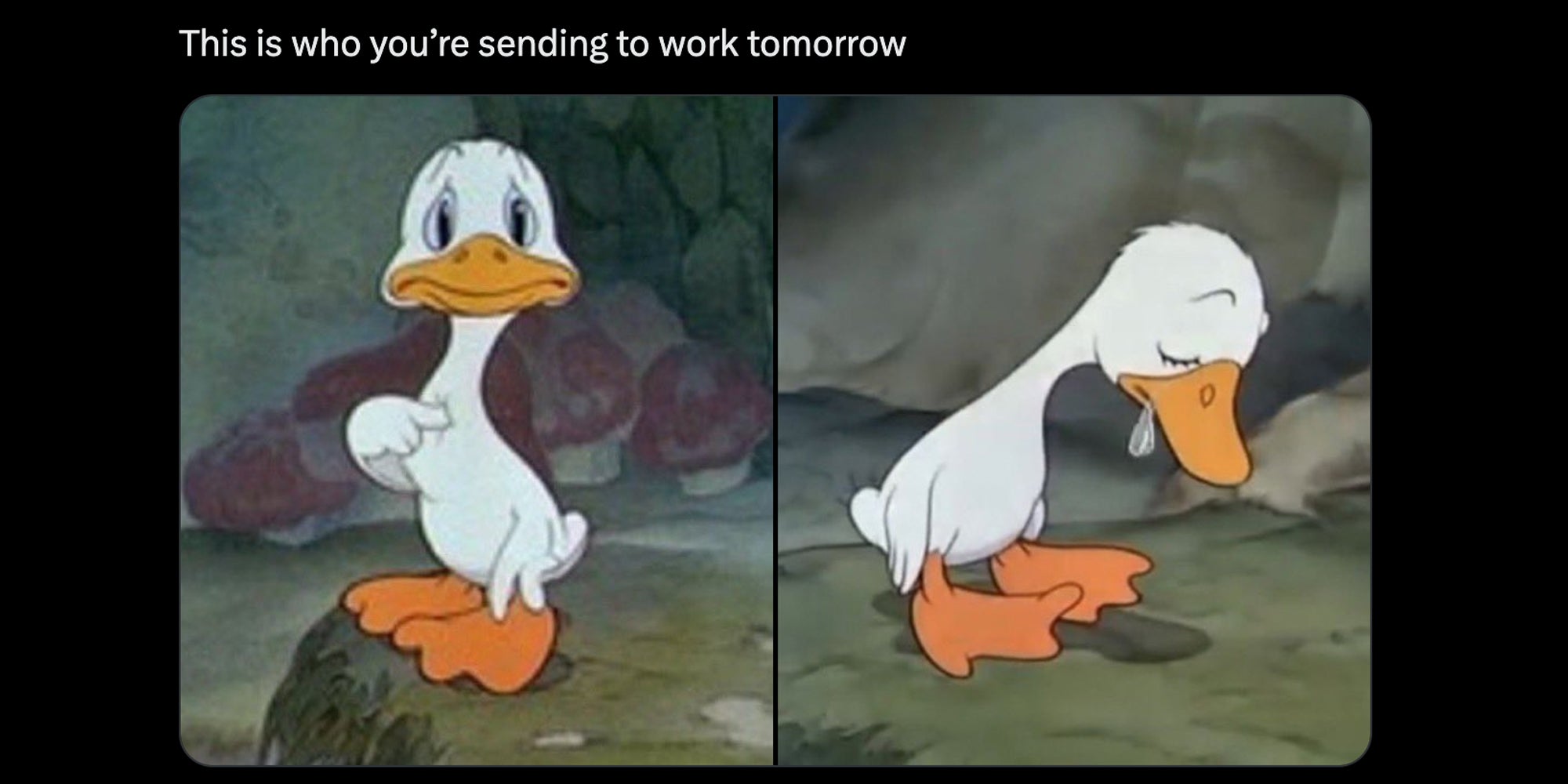
We’ve all been there. You wake up, look in the mirror, and realize you are the architect of your own problems. It's a specific kind of existential dread that words usually fail to capture. Then came the sad duck pointing at himself.
It’s a simple image, really. A yellow cartoon duck, eyes drooping with a heavy, relatable sadness, lifting a feathered finger to point directly at his own chest. There's no complex background. No flashy colors. Just a bird who has clearly had enough of his own nonsense.
Social media is a weird place. It’s mostly people pretending their lives are perfect, but the sad duck pointing at himself meme cuts through that noise. It’s honest. It’s basically the "It’s me, hi, I’m the problem, it’s me" of the animal kingdom, but with more feathers and less production value. People use it to signal that they know they messed up. Maybe you stayed up until 3:00 AM watching 10-year-old cooking competitions when you had a meeting at 8:00 AM. That’s a duck moment. Perhaps you spent your entire grocery budget on a limited-edition Lego set. Duck moment.
Where Did This Melancholy Bird Come From?
Tracing the origin of memes is often like trying to find the source of a river in a storm. Things move fast. The sad duck pointing at himself isn't a high-budget character from a Pixar movie or a mascot for a Fortune 500 company. He feels like a relic of the early 2000s internet—low-resolution, slightly "off" in his proportions, and undeniably expressive.
Digital culture experts often point toward sticker packs from messaging apps like LINE or WeChat as the breeding ground for these characters. These platforms are notorious for creating "reaction" characters that express hyper-specific emotions. While western audiences might see a "sad duck," the original creator likely intended to capture a feeling known in many Asian cultures as sang (丧)—a sort of "funeral-style" culture that celebrates being a bit of a loser or feeling unmotivated.
It’s a vibe.
Honestly, the duck’s anonymity is his strength. Because he isn't Donald or Daffy, he doesn't carry baggage. He doesn't have a voice actor or a canon backstory. He is just a vessel for our collective failures. When you see that image, you aren't thinking about a cartoon plot; you’re thinking about the time you accidentally replied "you too" to the waiter who told you to enjoy your meal.
The Psychology of Self-Deprecation in 2026
Why do we love this bird? Why is a sad duck pointing at himself a staple of group chats and Twitter threads?
Psychologists have long studied self-deprecating humor as a defense mechanism. By pointing at ourselves—literally, in the case of our feathered friend—we take the power away from the mistake. If I laugh at my own stupidity first, you can't hurt me by laughing at it. It’s a shield.
Dr. Peter McGraw, who runs the Humor Research Lab (HuRL), talks about the "Benign Violation Theory." For something to be funny, it has to be a violation (something is wrong) but also benign (it’s not actually dangerous). The duck is the perfect embodiment of this. The "violation" is our failure or sadness. The "benign" part is that it’s a tiny, round yellow bird.
It makes the pain manageable.
We live in an era of hyper-curation. Instagram and TikTok filters make everything look like a dream. In that context, the sad duck pointing at himself is a radical act of vulnerability. It says, "I am not a brand. I am a mess." This is why the meme tends to trend every time there's a major cultural "fail" or a relatable moment of collective regret.
Variations of the Vibe
Not every duck is the same. The internet has a way of iterating on perfection.
- The Single Tear Duck: Occasionally, you'll see a version where a single pixelated tear is rolling down his beak. This is for high-stakes regret.
- The Mirror Duck: A popular edit shows the duck looking into a mirror, pointing at his reflection. It’s meta. It’s deep. It’s mostly used when someone realizes they've become exactly what they promised they wouldn't.
- The Group Point: When a whole squad messes up, people will post multiple ducks. It’s a "we’re all in this together" moment of shame.
Why Simple Memes Outlast High-Def Videos
You might think that in 2026, with VR and AI-generated hyper-realistic content, a low-res sad duck pointing at himself would be obsolete. You’d be wrong.
Simplicity is the ultimate sophistication in meme culture. A high-definition video requires too much attention. A complex joke requires context. But the duck? You understand him in 0.5 seconds. He works across languages. A person in Tokyo and a person in New York can both look at that duck and feel the exact same "I am an idiot" energy.
It’s universal.
There's also the "shittiness" factor. In meme circles, "low-quality" or "deep-fried" images often carry more weight because they feel more authentic. They haven't been touched by a marketing department. They feel like they were made by a person in their bedroom at 2:00 AM, which is exactly where most of us are when we feel like that duck.
How to Use the Duck Without Looking Like a Boomer
Memes have a shelf life, but some become "classics." The sad duck pointing at himself has entered the hall of fame. However, there is an art to using him correctly.
Don't use it for genuine tragedies. That’s a "read the room" moment. The duck is for inconveniences and self-inflicted social wounds. If you forgot to pay your electric bill because you were busy researching whether or not penguins have knees, use the duck. If you accidentally liked a photo of your ex from 2014, use the duck.
If you use it to respond to a serious news story, you’re going to look out of touch.
Pro tip: The duck is best served without a caption. Let the finger do the talking. If you must add text, keep it brief. "Me." or "I've done it again." are acceptable. Anything longer ruins the comedic timing of the duck’s blank, sad stare.
The Future of Our Feathered Failure
Will we still be using the sad duck pointing at himself in five years? Probably.
The internet is cyclical. We move from irony to sincerity and back again. Right now, we are in a period of "post-ironic sincerity." We use memes to say things we are too embarrassed to say out loud. As long as humans continue to make mistakes—which, let's be honest, we're pretty good at—we will need a way to acknowledge those mistakes without spiraling into a total breakdown.
The duck is our safety valve.
He reminds us that being "the problem" is a universal human experience. Even ducks feel it. And in a world that feels increasingly fragmented, maybe a shared sense of being a bit of a disaster is the one thing that can still bring us together.
Actionable Takeaways for the Next Time You Feel Like the Duck
- Own the Fail: The moment you realize you’ve messed up, acknowledge it. Use the duck as a digital "my bad." It diffuses tension in almost any casual setting.
- Check the Context: Ensure your audience understands meme-speak. If you’re sending this to your boss, make sure your relationship is the "we joke about our errors" kind and not the "I am looking for a reason to fire you" kind.
- Keep a Folder: Every seasoned internet user has a "reaction" folder. Save a high-quality (or appropriately low-quality) version of the duck. You never know when you’re going to trip over your own feet in front of your crush.
- Don't Overthink It: The beauty of the duck is its lack of depth. Don't try to find a political message in it. Sometimes a sad duck is just a sad duck.
The next time you find yourself at the center of a self-made catastrophe, don't panic. Just find that image of the yellow bird, hit send, and let the world know that you know. You’re the duck. We’re all the duck. And honestly? That’s okay.
Instead of fighting the feeling of being "the problem," embrace the humor in it. The most successful people aren't the ones who never mess up; they're the ones who can point at themselves, laugh, and move on to the next mistake. The duck isn't just a meme; it's a lifestyle of radical self-accountability wrapped in a silly, yellow package. Save the image to your phone now so you don't have to frantically search for it when the inevitable happens.