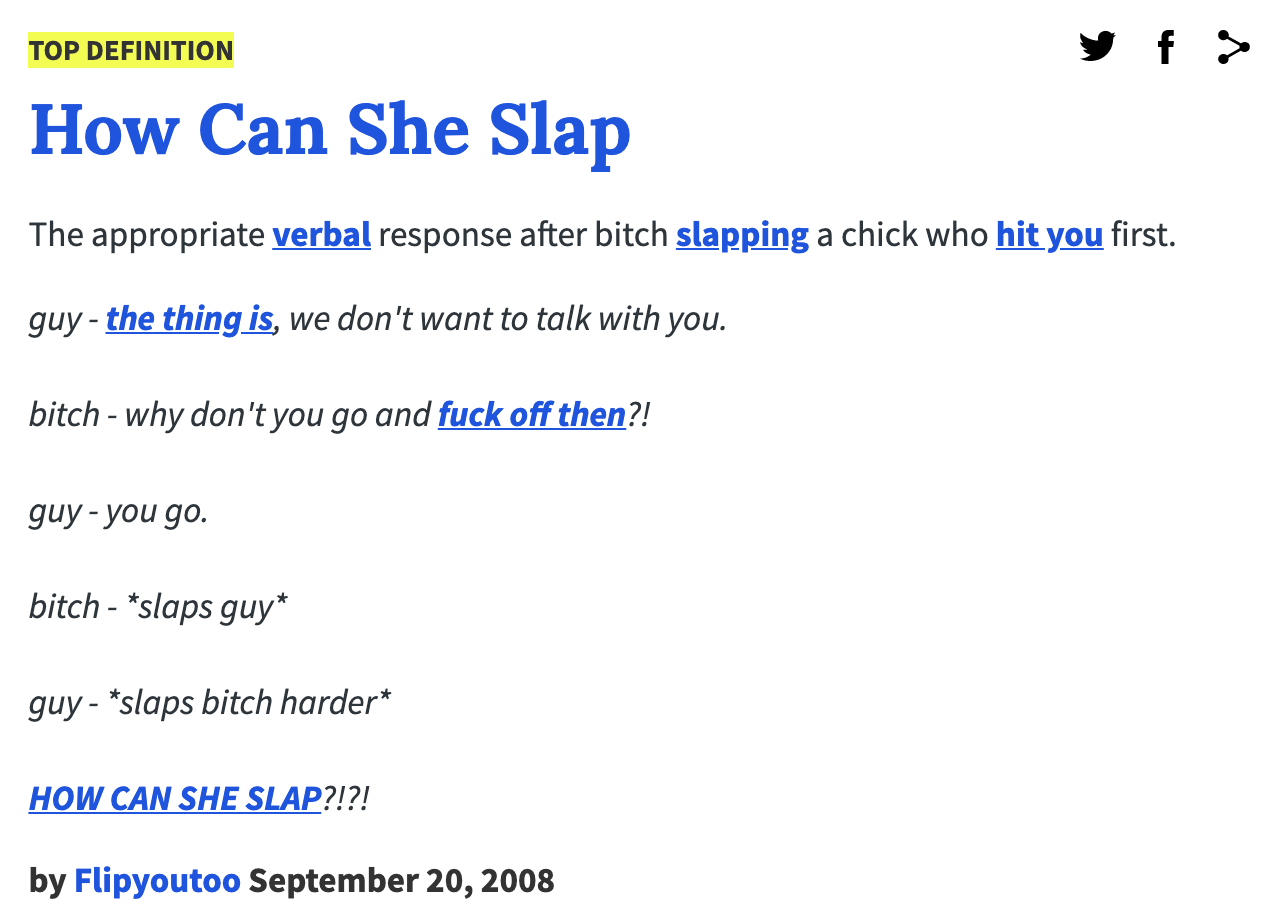
It happened in 2008. Most viral memes from that era have evaporated into the digital ether, but not this one. You’ve seen it. A grainy television set, a young man, a sudden outburst, and that high-pitched, desperate question that launched a thousand message board threads. The how can she slap gif is more than just a funny loop of a guy getting tackled; it’s a weirdly permanent artifact of early reality TV and a case study in how things go spectacularly wrong when the "script" hits reality.
The footage comes from a defunct Indian reality show called Dadagiri: Beat the Bullies. The premise was essentially a test of mental and physical grit, where contestants were subjected to verbal abuse by "bullies" played by actors. It was meant to be performative. It was meant to be controlled. But on that specific day, it became a legal and physical nightmare that effectively ended the show's reputation and spawned an immortal internet moment.
The Day Dadagiri Went Off the Rails
Let's look at the mechanics of the clip. Ravi Bhatia, the contestant in the video, was being berated by Esha Bhaskar, who played one of the "bullies." In the unedited footage, the tension is palpable, but it’s standard reality TV fare—until she actually strikes him across the face.
She slapped him. Hard.
Ravi’s reaction was instantaneous. He slapped her back with equal force. What follows in the how can she slap gif is the immediate aftermath: a swarm of male crew members descending on Bhatia, pinning him down and beating him while he shouts that iconic line. It’s a chaotic, messy scene that captures a specific kind of raw, unscripted panic.
People forget that this wasn't just a funny internet moment for Bhatia. He later spoke out in interviews about the trauma of the event. He was outnumbered. He was being physically assaulted by the production crew for a reaction that he claimed was instinctive. The show's producers allegedly wanted him to sign a "confession" or an apology, but he refused. Honestly, looking back at the footage with 2026 eyes, the power imbalance is staggering. The crew’s reaction was arguably far more violent than the initial exchange between the two performers, yet they felt emboldened because the "script" had been violated.
Why We Can't Stop Sharing the How Can She Slap Gif
Memes usually have a shelf life of about six weeks. This one has lasted nearly two decades. Why?
Part of it is the sheer absurdity of the phrasing. "How can she slap?" is grammatically just "off" enough to be catchy without being unintelligible. It’s a perfect linguistic hook. But the deeper reason is the debate it sparks. Every time the how can she slap gif resurfaces on Reddit, Twitter (X), or TikTok, it reignites a massive argument about gender roles, self-defense, and "equality" in physical altercations.
It’s a lightning rod.
Some see Bhatia as a victim of a double standard. Others see a man who overreacted to a staged environment. This constant friction keeps the content relevant. It’s not just a clip of someone falling over; it’s a philosophical debate packed into a low-resolution file. Plus, the transition from "reality TV drama" to "all-out brawl" happens in less than three seconds. It’s the ultimate "that escalated quickly" template.
The Career Aftermath for Ravi Bhatia
Most people in viral gifs disappear. They become "Success Kid" or "Bad Luck Brian" and that's it. Ravi Bhatia is a different story.
He actually leveraged the notoriety—eventually. After the dust settled and the legal threats faded, he stayed in the industry. He didn’t just fade away into obscurity. He became a legitimate actor, finding significant success in Indonesia and India. He starred in Jodha Akbar, a massive historical drama series. He’s a lead actor. He’s a public figure.
He basically outlived the meme.
It's rare to see a meme protagonist actually build a career that isn't just "being the guy from the meme." Bhatia managed to separate his professional identity from the guy screaming on the Dadagiri set, even if the internet refuses to let the footage go. Esha Bhaskar, on the other hand, largely retreated from the public eye after the incident. The backlash against her—and the show's production—was intense, especially as the clip traveled globally and viewers outside of India began to weigh in on the ethics of the production.
Behind the Scenes: The "Bully" Culture of 2000s TV
To understand why the how can she slap gif exists, you have to remember what TV was like in the mid-to-late 2000s. We were in the era of The Surreal Life, Flavor of Love, and Bad Girls Club. Producers were desperate for "organic" conflict. They pushed boundaries. They encouraged actors to be as vile as possible to get a rise out of contestants.
Dadagiri was India’s attempt to tap into that "mean" energy.
The problem? The producers didn't account for human instinct. When you train an actor to bully people and tell a contestant to take it, you're playing with fire. The moment Bhaskar slapped Bhatia, the "social contract" of the show broke. Bhatia wasn't a contestant anymore; he was a guy who just got hit. The crew wasn't "production" anymore; they were a mob.
Legal and Ethical Fallout
The incident led to police complaints. Bhatia alleged he was physically beaten and that his phone was taken. There were talks of lawsuits. While the show tried to paint Bhatia as the villain for hitting a woman, the public sentiment—facilitated by the internet's ability to watch the clip on loop—shifted toward him. People saw the crew's reaction as a massive overreach.
This is a key part of the gif's history. It represents a moment where "Kayfabe" (the professional wrestling term for staying in character) died on national television. It was the first time many viewers realized how dangerous these "controlled" reality environments could be.
Technical Legacy and Digital Longevity
If you look at the how can she slap gif today, it looks like it was filmed through a potato. The resolution is terrible. The audio in the video versions is peaking.
Ironically, this adds to its "authenticity."
In an era of high-definition, AI-upscaled content, there is something deeply "internet" about a 240p clip that survives through sheer force of will. It belongs to the era of YouTube's infancy. It’s a digital heirloom. It’s also incredibly versatile for modern social media. You can use it to react to a sudden bill, a surprising plot twist in a movie, or an unfair comment from a boss. It has moved past its original context and become a universal shorthand for "This is fundamentally unfair."
How to Find the Best Versions Today
If you’re looking for a high-quality version of the how can she slap gif, you’re mostly out of luck. The original master tapes are likely buried in a vault or lost. However, several archival sites and YouTube channels have uploaded "remastered" versions where the audio is cleaned up so you can hear the smack more clearly.
- Giphy/Tenor: Best for quick reactions in DMs.
- Reddit Archives: Best for finding the full 20-minute context of the episode.
- YouTube Documentaries: Several creators have done deep dives into Bhatia’s career, showing clips that aren't just the slap.
The Reality of Reality TV Safety
What can we actually learn from this? Beyond the jokes and the loops?
The how can she slap gif stands as a warning for television production. Since 2008, safety protocols on sets have changed drastically. You can’t just have actors hitting contestants anymore. There are liability waivers, sure, but there are also "safe words" and much tighter security presence that isn't allowed to intervene unless there's a genuine threat.
The incident was a turning point for Indian reality TV, specifically. It forced a conversation about what "entertainment" meant and whether a contestant's dignity—or physical safety—was worth the ratings. The show Dadagiri didn't last much longer after that season, and its legacy is now entirely tied to those few seconds of chaos.
Moving Forward: How to Use the Meme Responsibly
When you post the how can she slap gif, you're participating in a piece of media history that actually hurt people. It’s okay to find the absurdity funny—most of us do—but knowing the context changes how you see the faces in the frame.
- Check the context: Recognize that Ravi Bhatia is a successful actor now, which makes the gif a little easier to stomach. He’s fine. He moved on.
- Avoid the toxicity: The gif is often used in "gender war" debates. Avoid falling into those traps. It’s a clip of a production failure, not a manifesto on human rights.
- Appreciate the timing: Watch the transition between the slap and the tackle. It’s a masterclass in chaotic editing and real-time reaction.
The gif isn't going anywhere. It’s baked into the foundation of the internet. It will likely be around in 2036, still grainy, still loud, and still asking that same, impossible question. It’s a reminder that sometimes, the most "real" thing about reality TV is the moment the cameras were supposed to stop, but didn't.
If you're looking to dive deeper into this era of television, your best bet is to look up archival interviews with the cast from the 2010s, where they finally felt safe enough to talk about what actually happened when the microphones were turned off. Most of the original footage has been scrubbed from official platforms, so third-party archives are your only real window into the full, uncut disaster.