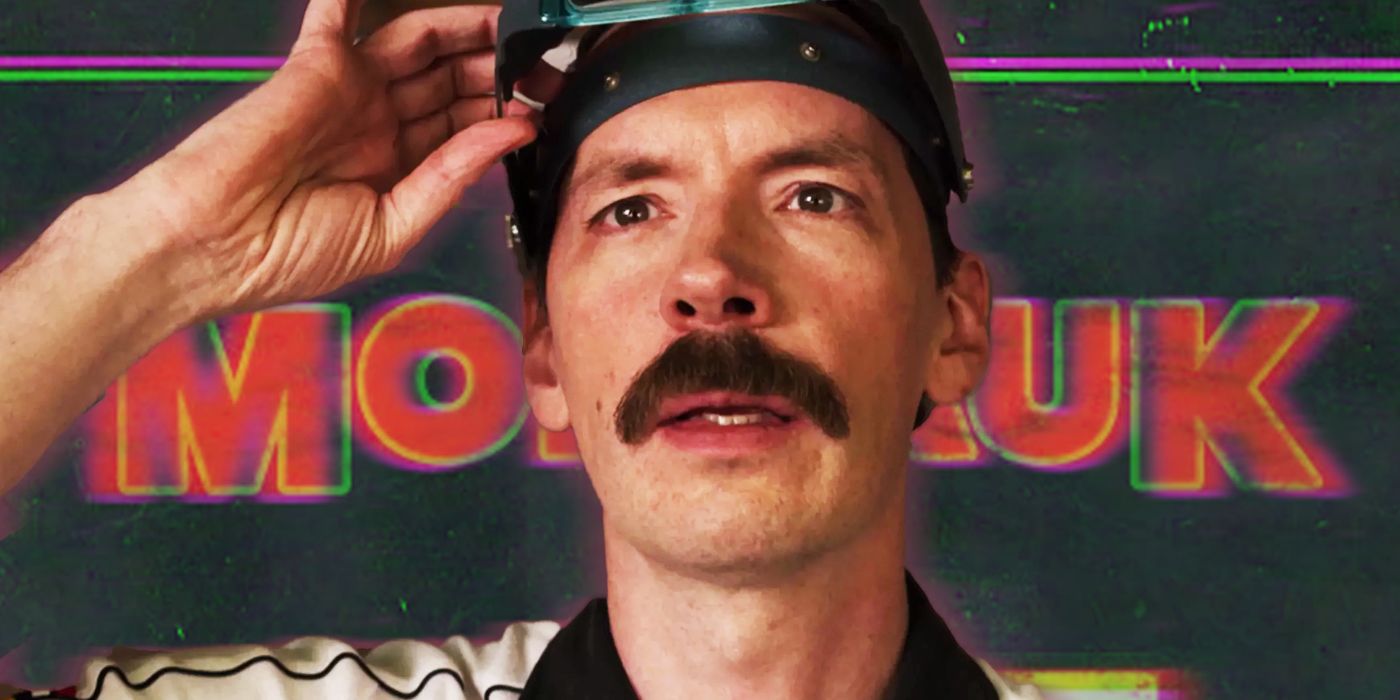
Scott Clarke is just a middle school science teacher. He’s got a great mustache, a healthy obsession with 1980s radio technology, and a girlfriend who likes watching The Thing on date night. But honestly? Without him, the kids in Hawkins would’ve been Demogorgon food within the first three episodes. Mr. Clarke from Stranger Things represents a specific kind of TV archetype that we don't see enough of anymore—the genuinely competent, supportive mentor who isn't actually "in" on the secret.
Think about it. Most adults in Hawkins are either actively malicious, like the crew at the lab, or completely oblivious. Mr. Clarke is different. He’s the intellectual engine of the show. He provides the theoretical framework for everything from the Upside Down to sensory deprivation tanks, and he does it all while maintaining a lesson plan for a bunch of pre-teens.
The Curiosity Door is Always Open
The first time we really see the impact of Mr. Clarke from Stranger Things, it’s through the lens of the "A-V Club." For Mike, Dustin, and Lucas, the Heathkit ham radio isn't just a toy; it’s a lifeline. And Clarke is the guy who trusts them with it. He doesn't talk down to them. He treats their curiosity like a serious pursuit.
When Dustin calls Mr. Clarke at 10:00 PM on a Saturday night to ask how to build a sensory deprivation tank, Clarke doesn't just hang up. Sure, he’s annoyed. He’s in the middle of a movie. But he answers. He explains the physics of salt density and water displacement. Why? Because he believes that "the curiosity door" should never be closed. That single phone call is what allows Eleven to find Will in the Upside Down. Without that specific bit of "extracurricular" instruction, the mission fails. Period.
It’s easy to forget how much heavy lifting Mr. Clarke does for the plot. He explains the "Acrobat and the Flea" analogy, which is basically the only reason the audience (and the characters) understands how a tear in spacetime works. He’s the bridge between high-concept sci-fi and the gritty reality of a small Indiana town.
More Than Just an Exposition Machine
A lot of writers use teacher characters as "exposition dumps." You know the type. The character exists only to explain a plot point and then disappears. But Scott Clarke feels like a real person. We see glimpses of his life—his interest in Cosmos by Carl Sagan, his awkward but sweet interactions with the boys' parents, and his genuine grief when he thinks Will Byers has died.
There’s a specific scene at Will’s funeral where Clarke talks to the boys. He’s mourning a student, but he’s also trying to be the emotional anchor they need. It’s a subtle performance by actor Randy Havens. He brings this warmth that makes you wish you had a teacher like that. He’s the guy who would’ve encouraged you to join the science fair even if you were the only kid showing up.
The Physics of the Upside Down
Let's get technical for a second because Clarke would want us to. The "Acrobat and the Flea" isn't just a clever bit of writing; it’s based on real-world theoretical physics concepts regarding extra dimensions. While the show leans into the supernatural, Mr. Clarke grounds it in the theoretical. He mentions the "Many-Worlds Interpretation" of quantum mechanics. This wasn't just flavor text. In the mid-80s, these were burgeoning conversations in the scientific community.
By having Mr. Clarke from Stranger Things explain these concepts, the Duffer Brothers give the show a sense of "hard" sci-fi legitimacy. It’s not just magic. It’s science we don't understand yet. That’s a crucial distinction. It makes the threat of the Upside Down feel like a biological and physical reality rather than a ghost story.
Why He Disappeared (and Why We Miss Him)
As the show progressed into Season 3 and Season 4, we saw less of Mr. Clarke. The kids grew up. They went to high school. The stakes moved away from the middle school A-V club and into the Starcourt Mall and the Creel House. But the absence of Scott Clarke is felt.
In Season 3, he has a brief, brilliant moment with Joyce Byers. She comes to him because her magnets are falling off her fridge. It’s a weird, domestic mystery. Clarke, being the nerd he is, gets incredibly excited about the possibility of a massive electromagnetic field. He even has a scale model of a solenoid in his garage. This scene is vital because it proves that Clarke’s brilliance isn't limited to the classroom. He’s a natural problem solver. He helps Joyce realize that something is fundamentally wrong with the town’s physics, which leads her to the secret Russian base.
Then, in Season 4, he’s mostly gone. The kids are dealing with Vecna and high school social hierarchies. While the new characters like Eddie Munson are fantastic, there’s a missing piece of the puzzle where Clarke used to be. He was the "voice of reason" that wasn't cynical.
What Most Fans Get Wrong About Him
People often think Mr. Clarke is just a "cool teacher." That’s a bit of an undersell. He’s actually a bit of an outcast himself. Think about the town of Hawkins in 1983. It’s a basketball town. It’s a town of hunters and blue-collar workers. A guy who spends his weekends building ham radios and talking about theoretical dimensions is a weirdo in that environment.
He sees himself in Mike, Dustin, and Lucas. He’s protecting them. Not from monsters—he doesn't know about those—but from the crushing boredom and conformity of small-town life. He gives them a sanctuary. That’s his real superpower. It’s not his knowledge of salt-to-water ratios; it’s his empathy.
Reality Check: The 1980s Science Teacher
If you look at the history of education in the 80s, teachers like Clarke were the ones who paved the way for the tech boom of the 90s. They were the ones bringing the first Apple II computers into classrooms. They were the ones starting robotics clubs before that was a "cool" resume builder. Mr. Clarke from Stranger Things is a tribute to that specific generation of educators who saw the future coming and tried to prepare their students for it.
How to Channel Your Inner Scott Clarke
If you’re a fan of the show, there’s actually a lot to learn from how this character operates. He doesn't have telekinetic powers. He isn't a "badass" with a spiked bat. He’s just a guy who knows things and cares about people.
- Stay Curious. Don't stop asking "why." Whether it's magnets or the nature of reality, the minute you stop asking questions is the minute you stop growing.
- Support the Outcasts. If you see someone with a niche interest, don't mock it. Lean into it. You might be the only person who gives them the confidence to pursue a life-changing career.
- Explain the Complex Simply. The best way to master a subject is to explain it to someone else. Use analogies. Use the "Acrobat and the Flea."
- Keep the Radio On. metaphorically speaking, stay connected to the world around you. You never know when someone is going to call you with a "code red."
The legacy of Mr. Clarke from Stranger Things isn't just about the plot points he solved. It’s about the culture of curiosity he fostered in Hawkins. He reminds us that intelligence is a tool for good, and that being a "nerd" is really just another word for being passionate about the truth.
Next time you watch the series, pay attention to the scenes in the science lab. Look at the posters on the walls. Look at the way he handles the equipment. There’s a level of detail in his characterization that proves the creators loved him as much as we do. He’s the unsung hero of the story, the man who built the foundation that let the heroes stand tall.
To really appreciate the character, go back and re-watch Season 1, Episode 7, "The Bathtub." Pay close attention to the joy in his voice when he explains the deprivation tank. That’s the heart of the show right there. Pure, unadulterated wonder. We could all use a little more of that.
Check out the real-world science behind the show by looking into the "Many-Worlds Interpretation" or the history of the Heathkit company. It adds a whole new layer to his character when you realize just how grounded his "fiction" really was.