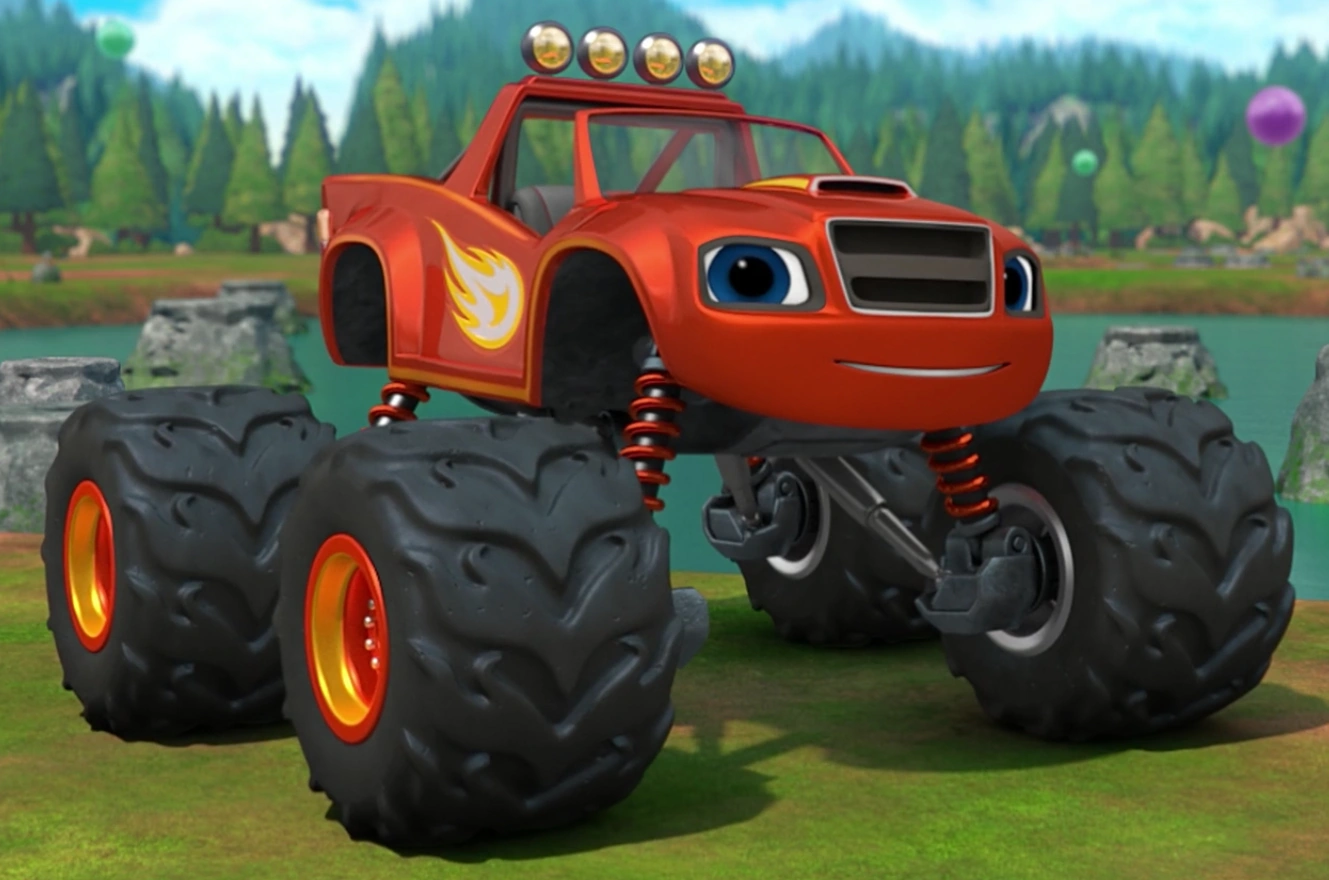
If you have a preschooler, you probably have the theme song permanently etched into your brain. You know the one. It’s loud, it’s catchy, and it’s all about a red truck with a giant heart. Blaze and the Monster Machines characters aren't just colorful vehicles designed to sell toys—though they do that very well—they are actually built around a pretty clever educational hook. STEM. Science, technology, engineering, and math. It's rare to see a show for three-year-olds talking about trajectory or friction, but here we are.
Honestly, the show works because the characters have distinct, almost archetypal personalities. It’s a classic ensemble cast, just with more tires and torque. You’ve got the hero, the sidekick, the rival, and the specialist.
The Red Truck That Does It All
Blaze is the star. Obviously. He’s the only truck in Axle City with a human driver, AJ. That dynamic is actually kind of weird if you think about it too hard, but in the context of the show, it works. AJ is the one who provides the technical data, while Blaze provides the muscle.
Blaze is basically the Superman of trucks. He’s fast. He’s brave. He can transform into literally anything. Need a hydrofoil? He’s got it. Need a crane? Done. The most iconic part of his character, though, is the Blazing Speed. It’s the show's version of a "turbo boost," and it’s usually the climax of every episode. To get it, the kids at home have to shout "Leeeeeet’s Blaze!" It’s interactive, it’s high energy, and it makes Blaze the undisputed leader of the pack.
Unlike some other kids' show protagonists who can be a bit whiny or overly perfect, Blaze is genuinely likable because he spends most of his time helping his friends solve problems. He’s an altruist with a V8 engine.
AJ: The Brains Behind the Wheel
AJ is an eight-year-old tech genius. That’s a lot of responsibility for a kid who isn't even old enough for a learner's permit. He’s not just a passenger; he’s the strategist. He uses his Visor View to see things the others can’t—calculating angles, measuring distance, and identifying the scientific principles needed to get out of a jam.
What's cool about AJ is how he talks directly to the audience. He treats the viewer like a partner in engineering. He doesn’t talk down to kids. When he explains mass or volume, he does it with the assumption that the kid on the couch is smart enough to get it. That’s a huge part of why the show sticks.
The Rivalry: Crusher and Pickle
Every hero needs a foil. Enter Crusher.
Crusher is a big, blue tractor-trailer who is, quite frankly, a bit of a disaster. He’s the antagonist, but he’s more of a "bumbling villain" than a truly scary one. His whole deal is cheating. He can't stand that Blaze is faster or better liked, so he builds ridiculous contraptions to slow everyone else down.
His schemes always backfire. Always.
It’s a classic "Cheaters never win" lesson, but it’s played for laughs. Crusher’s ego is his biggest obstacle. Then you have Pickle, his tiny monster truck sidekick. Pickle is the moral compass that Crusher constantly ignores. He’s hilarious because he’s usually the one pointing out why Crusher’s plan is going to fail, and he does it with a weirdly cheerful attitude.
Pickle is arguably the funniest character in the show. He loves Crusher, but he’s not blind to his flaws. Their dynamic is pure comedy gold for the target demographic.
The Support Crew: More Than Just Backstory
Axle City is populated by a bunch of other monster trucks that fill out the world. They aren't just background noise; they bring different "skills" to the table.
Stripes
Think of Stripes as the athlete. He’s a truck with tiger stripes (hence the name) and tiger-like abilities. He can climb, he has "tiger claws," and he’s incredibly agile. He’s the one you want if you’re stuck in a jungle or need someone to scale a mountain.
Starla
Starla is a purple cowgirl truck. She’s got a lasso and a Southern twang. She’s the heart of the group, often bringing a bit of common sense to the more chaotic moments. She’s also a reminder that the world of Blaze and the Monster Machines characters is diverse in its interests—even if those interests are "being a cowboy truck."
Darington
Darington is the stuntman. He loves big jumps, loops, and anything that involves a bit of risk. He’s not always the smartest truck in the room, but he has the most guts. Kids love him because he represents the "cool" side of monster trucks—the part that’s all about the spectacle.
Zeg
Zeg is part dinosaur, part monster truck. He speaks in the third person ("Zeg smash!") and is incredibly strong. He’s the powerhouse. His character design is a stroke of genius because, honestly, what kid doesn't love dinosaurs AND trucks? It’s a literal mashup of the two most popular toddler obsessions.
Watts
Added a bit later in the series, Watts is an electric monster truck. This was a smart move by the creators to modernize the show. She’s powered by electricity, has specialized tires for speed, and brings a slightly different "energy" (literally) to the group. She’s fast, bright, and very tech-focused.
Gabby: The Mechanic
Gabby is the only other human regular besides AJ. She’s nine years old and runs the Axle City Garage. If a truck has a flat tire or a broken axle, Gabby is the one who fixes it.
She’s a great character because she breaks the "damsel in distress" trope. She’s the expert. She’s the one with the tools. When Blaze and his friends are in trouble, they don't look for a grown-up; they look for Gabby. She’s a role model for kids interested in how things actually work under the hood.
Why the Character Designs Matter
Look closely at these trucks. They aren't just random shapes. Every character is color-coded and has a silhouette that is immediately recognizable.
- Blaze: Red (Leadership, Energy)
- Crusher: Blue (Cold, Rivalry)
- Starla: Purple (Creativity, Friendliness)
- Zeg: Green (Nature, Strength)
This isn't an accident. It helps toddlers track who is who during fast-paced chase scenes. The simplified color palettes allow kids to identify their favorites instantly on a toy shelf, sure, but it also helps them follow the narrative beats of the story without getting confused.
Science in Disguise
The genius of these characters is how they introduce complex concepts. Take an episode about buoyancy. Instead of a dry lecture, you have Blaze trying to cross a river while Crusher tries to sink him.
The characters make the science "active." When Blaze transforms into a boat, he explains why he needs a certain shape to stay afloat. When Darington tries a jump, he talks about force and gravity. It turns the characters into teachers, but because they are "cool" monster trucks, the kids don't realize they're learning.
It’s sneaky education. And it’s highly effective.
What Most People Get Wrong
People often think Blaze is just another loud car show. It’s not. Unlike Cars or Hot Wheels, the focus here is strictly on problem-solving through STEM.
Another misconception? That the show is just for boys. The inclusion of characters like Starla, Watts, and especially Gabby has given the show a huge following among girls. Gabby isn't just a "girl character"—she's the most capable mechanic in the entire city. That matters.
Real-World Impact of Axle City
Believe it or not, there have been studies on how shows like this affect early childhood development. According to research from organizations like The Center on Media and Child Health, high-quality educational programming can significantly improve a child's vocabulary and understanding of physical concepts.
When a kid watches Blaze, they aren't just zoning out. They are being asked to participate. They are asked to count, to identify shapes, and to predict what will happen next based on the laws of physics. It’s "active viewing."
How to Use These Characters for Learning
If you’re a parent or educator, you can actually use these characters to jumpstart real-world activities. It doesn't have to stay on the screen.
- Gravity Experiments: Use a toy Blaze (or any car) and a ramp. Change the height of the ramp. Ask the child: "Will Blaze go faster if the ramp is higher?" This is exactly what AJ would do.
- Simple Machines: Point out levers or pulleys in the real world and relate them back to Gabby’s garage.
- Vocabulary Building: Use the show's "big words" like centripetal force or acceleration in everyday conversation. You’d be surprised how fast a four-year-old can learn a three-syllable word if it’s associated with a cool truck.
The Longevity of the Brand
Blaze and the Monster Machines has been around since 2014. In the world of preschool TV, that’s an eternity. The reason it stays relevant is the constant rotation of new themes—Robot Riders, Fire Rescue, Polar Derby.
By putting the core characters in new environments, the show stays fresh. But the heart remains the same: a kid and his truck solving problems with science.
Actionable Insights for Parents
If your child is obsessed with Blaze and the Monster Machines characters, don't fight it. Lean into it.
- Check out the official Nick Jr. site: They have printable STEM worksheets that use the characters to teach basic math and logic.
- Look for the books: The Little Golden Books and leveled readers are great for transitioning that "truck love" into "reading love."
- Discuss the "lesson": After an episode, ask your kid what the "big word" of the day was. It reinforces the memory and makes the screen time feel a bit more productive.
The show is a tool. Use the characters as a gateway to talk about how the world works. Whether it’s talking about why a ball rolls (friction) or why a bridge stays up (engineering), Blaze gives you the language to start those conversations early.
To get the most out of the show's educational potential, watch an episode with your child and try to identify the "problem of the day." Ask them how they would solve it before Blaze does. This encourages critical thinking and helps them move from passive consumption to active engagement with the STEM concepts being presented. You can also find specific "STEM episodes" on streaming platforms that focus on singular topics like magnetism or light reflection, which are perfect for targeted learning moments at home.