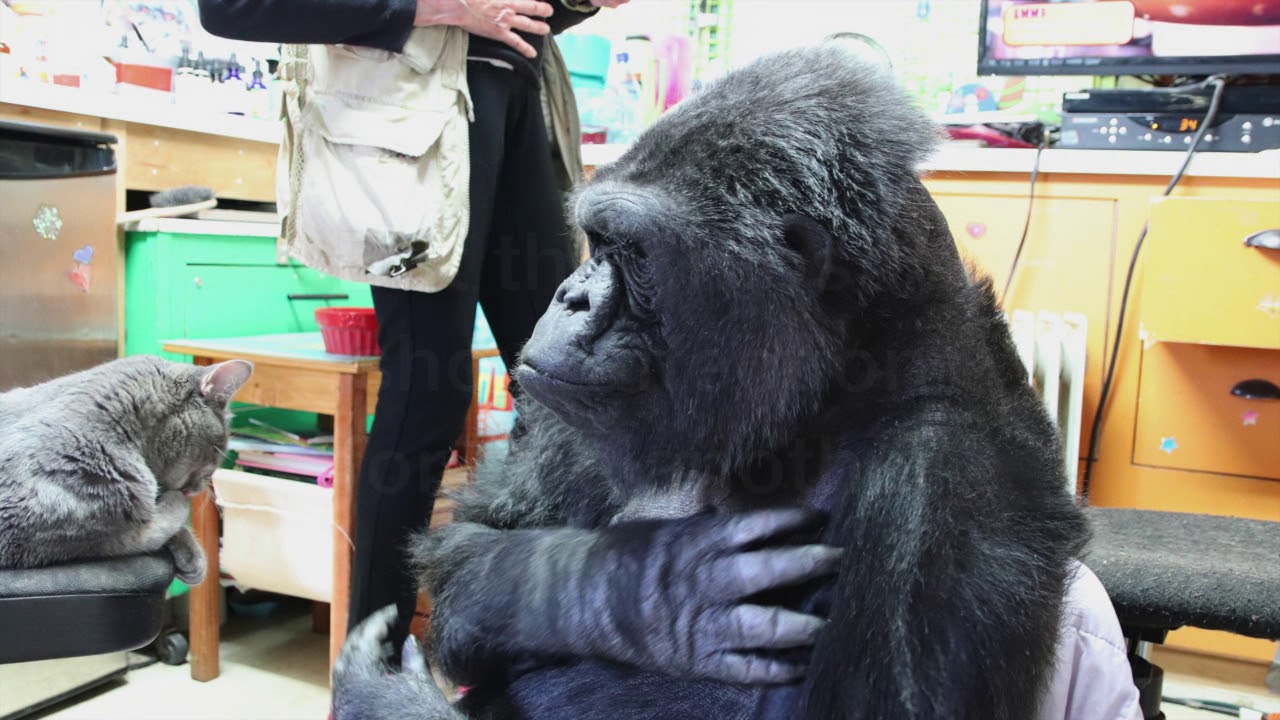
Most people remember Koko. She was the world-famous Western lowland gorilla who mastered American Sign Language (ASL) under the tutelage of Dr. Francine "Penny" Patterson. But if you dig into the archives of the Gorilla Foundation, you’ll find a story that’s way more emotional than just a primate learning to sign "apple" or "ball." It’s the story of Koko's kitten, a tiny gray tabby she named All Ball, and the subsequent feline companions like Cocoa and Lipstick that redefined what we thought we knew about animal empathy.
It wasn't a stunt. Honestly, that’s the first thing people get wrong. When Koko started asking for a cat in the early 80s, researchers didn't just hand her a kitten for a photo op. She actually signed the word for "cat" repeatedly. She was specific. When they gave her a stuffed animal, she was annoyed. She didn't want a toy; she wanted something that breathed.
Why a Gorilla Wanted a Kitten Named All Ball
In 1984, Koko was finally allowed to choose a kitten from a litter for her birthday. She bypassed several others and picked a gray-and-white Manx. Because the kitten lacked a tail and looked like a little sphere, Koko signed the words "All Ball."
This relationship changed the trajectory of interspecies research.
Koko didn't treat the kitten like a toy. She treated it like a baby gorilla. She would carry All Ball on her back, try to nurse him, and spent hours gently petting him with those massive, powerful fingers that could have easily crushed him. It’s wild to think about the muscle control required for a 300-pound gorilla to play "tickle" with a three-pound ball of fur.
The tragedy hit a few months later. All Ball escaped the enclosure and was hit by a car.
When Penny Patterson told Koko what happened, the gorilla's reaction was devastatingly human. She signed "Cry, sad, frown" and "Sleep cat." Later, cameras caught her alone in her room, letting out a high-pitched whimpering sound—the specific noise gorillas make when they are mourning. This wasn't just "animal behavior." It was grief. Pure and simple.
Enter Cocoa and the Legend of the Red-Furred Friend
After the mourning period for All Ball, Koko eventually felt ready for more companionship. This is where Cocoa comes into the picture.
Actually, to be precise, Koko was given two kittens in 1985: a red tabby she named Lipstick and a smoky gray one she named Smoky. But because of the way the story circulated in media like National Geographic, the names often get jumbled in the public consciousness. "Cocoa" became a nickname or a misremembered moniker for some of the cats in the lineage of felines that lived at the Gorilla Foundation in Woodside, California.
Koko’s interactions with these cats were less about "science" and more about "personality."
She had specific games she played with them. She’d sign "Tickle" and then wait for the kitten to pounce on her hand. If the kitten bit her too hard (as kittens do), Koko would sign "Obnoxious" or "Nut." She had a dry sense of humor.
The Nuance of Interspecies Bonding
Scientists like Dr. Ronald Cohn observed that the presence of the kittens stabilized Koko’s mood. Gorillas are intensely social. While she had her human caretakers and her gorilla companion, Michael, the kittens provided a different kind of "nurture" outlet.
- Koko used the kittens to communicate complex emotions.
- She showed a preference for "soft" and "pretty" things.
- The kittens seemed entirely unafraid of her.
It's sorta fascinating when you think about it. The kittens didn't see a "beast." They saw a warm, giant, hairy mountain that gave great chin scratches.
The Controversy You Don't Usually Hear About
Not everyone was a fan.
Some primatologists, like Herbert Terrace (the man behind the Nim Chimpsky project), were skeptical. They argued that Penny Patterson was "over-interpreting" Koko’s signs. They suggested that when Koko signed about her kitten, she was just mimicking prompts to get treats.
But if you watch the raw footage? It’s hard to stay a skeptic.
When you see a gorilla looking at a picture of a kitten and signing "Visit," or when she looks at a photo of All Ball months after he died and signs "In hole," referring to his burial, that’s not a trick. That’s a memory. It shows a level of cognitive permanence that many scientists at the time were unwilling to grant to non-human animals.
What Koko’s Cats Taught Us About Conservation
We often think of conservation as just "saving land." But the story of Koko's kitten made the struggle of the Western lowland gorilla relatable to the average person.
Before Koko, gorillas were "King Kong." They were monsters.
After Koko and her cats, they were sensitive, intelligent beings capable of loving a different species.
This shift in public perception was massive for fundraising and protective legislation. It’s a lot harder to ignore the poaching of an animal that you've seen gently cradling a tabby cat.
The Reality of Managing Large Primates with Pets
Logistically, this was a nightmare for the staff.
You can’t just toss a cat in a cage. The kittens had their own "safe zones" where they could retreat if Koko got too boisterous. The staff had to monitor every second of interaction. There were also health concerns—zoonotic diseases can jump between species. The kittens had to be strictly indoor cats with regular vet checks to ensure they weren't bringing anything to Koko that could compromise her respiratory system.
The Legacy of the Gorilla Kitten
Koko passed away in 2018, but the impact of her relationships with those cats remains. It proved that the "human" traits of empathy and mourning aren't exclusive to Homo sapiens.
If you're looking for the "takeaway" here, it's that intelligence isn't just about solving puzzles or using tools. It's about the capacity for connection. Koko didn't need to sign "I love you" in a perfect sentence for us to see that she cared for those animals. She showed it in the way she moved, the way she protected them, and the way she grieved when they were gone.
Basically, the story of Koko and her kitten serves as a bridge. It reminds us that the line between us and the rest of the animal kingdom is way thinner than we’d like to admit.
Actionable Steps for Animal Lovers
If this story moves you, don't just leave it as a "cute fact" in your head.
- Support Habitat Enrichment: Many zoos now use "companion animals" for lonely cheetahs or primates based on the foundational observations made with Koko. Support facilities that prioritize psychological enrichment over just "display."
- Educate on Great Ape Intelligence: Use the Koko story to advocate for higher standards of care for captive primates. The Gorilla Foundation still works on these issues.
- Manx Awareness: If you fell in love with All Ball’s look, research the Manx breed. They are incredibly social cats, but they have specific spinal health needs due to the gene that causes their lack of a tail.
- Adopt, Don't Shop: Koko’s kittens were often rescues or from litters needing homes. The best way to honor that legacy is to provide a home for a cat that needs one.
The bond between a 300-pound gorilla and a tiny kitten remains one of the most poignant moments in 20th-century biology. It wasn't just about a "pet." It was about two different worlds finding a common language in the simple act of being together.