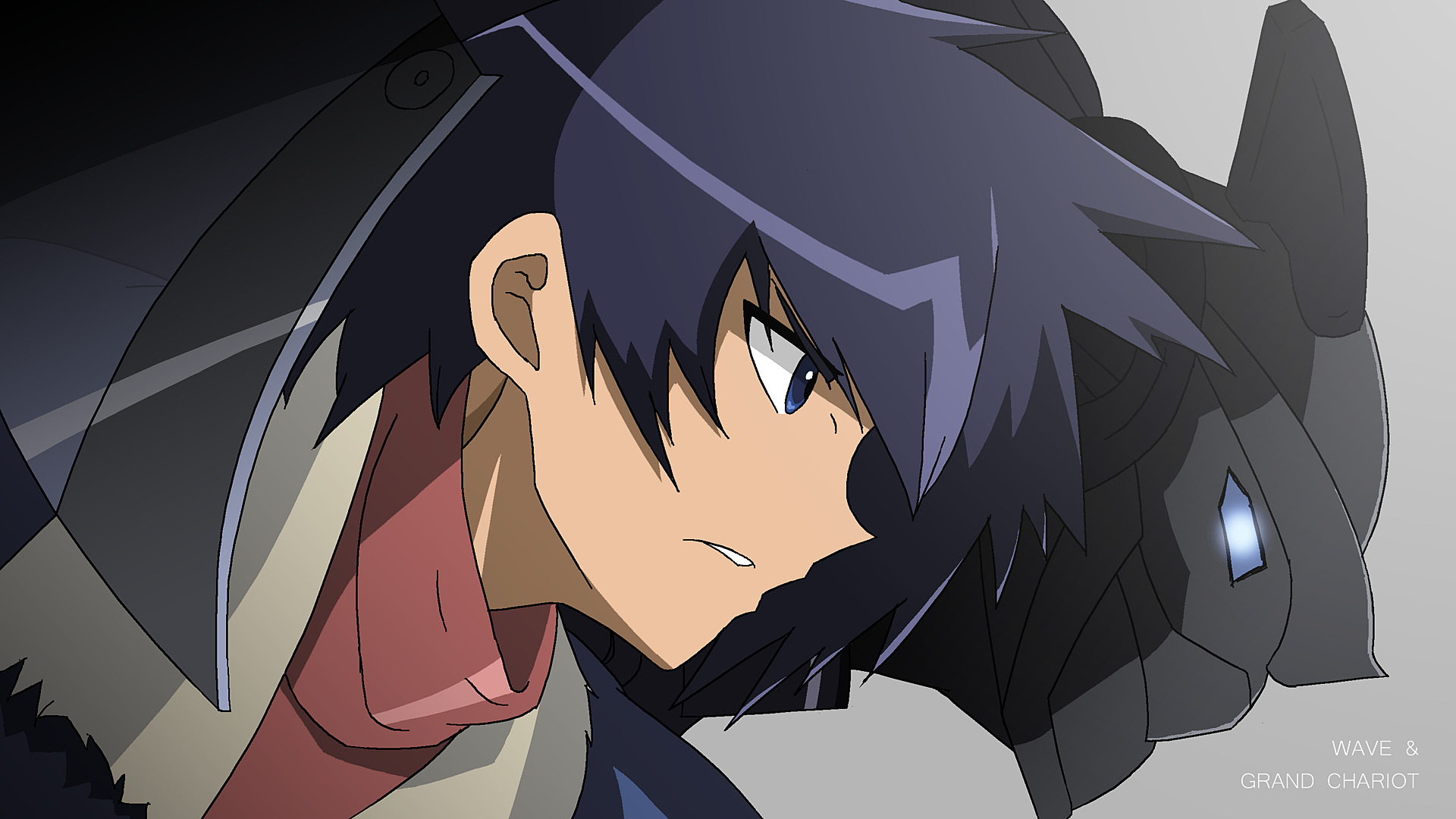
Wave is probably the only guy in the entire series who isn't a complete psychopath. Let's be real. When you dive into Wave Akame ga Kill, you're usually met with a wall of edgy assassins, sadistic generals like Esdeath, and enough gore to fill a swimming pool. Then there's Wave. He’s just a guy from a small fishing village who wants to do his job. He’s the "country bumpkin" trope turned on its head because, unlike Tatsumi, he ends up on the "evil" side. But calling him evil is a stretch. It’s honestly more like he just clocked into the wrong office on his first day of work.
He’s fascinating.
Most fans compare him to Tatsumi immediately because their powers are basically mirror images. Tatsumi has Incursio; Wave has Grand Chariot. They both wear the "armor" type Teigu. They both have that fiery protagonist energy. However, while Tatsumi joins Night Raid to tear the system down, Wave joins the Jaegers to protect the peace. He genuinely believes that the Empire can be saved from the inside, which, looking back, was incredibly naive but also deeply human.
The Grand Chariot Factor: More Than Just Blue Incursio
People call Grand Chariot "the blue Incursio" all the time, and while it’s a fair shorthand, it misses the technical nuances that Takahiro (the writer) baked into the lore. Grand Chariot was created as a successor to Incursio. It’s more stable. It doesn't have that pesky "eating its host" problem that eventually turned Tatsumi into a dragon. Wave’s Teigu is a masterpiece of Empire engineering, focused on raw physical enhancement and flight.
Actually, the flight aspect is huge. Wave’s ability to maneuver in the air gave him a tactical edge that most of Night Raid struggled to counter. But the real kicker? Wave is one of the few people in history to successfully use two Teigu at the same time. During the climax of the manga, he dons both Grand Chariot and Ran’s wings, Mastema.
That shouldn't be possible.
The lore explicitly states that the mental and physical strain of wielding two Imperial Arms is fatal for almost everyone. Wave pulls it off because his willpower is rooted in something other than bloodlust—he does it for Kurome. It’s a moment of pure shonen hype that feels earned because we’ve seen him get kicked around for fifty chapters. He isn't a prodigy. He's a hard worker who refuses to let his friends die.
Why Wave Survived When Everyone Else Died
If you’ve finished the Wave Akame ga Kill journey, you know the body count is astronomical. It’s a literal bloodbath. Yet, Wave walks away. Why?
It’s about his moral compass. Wave is the "neutral good" anchor in a "chaotic evil" sea. He’s the only Jaeger who treats his teammates like actual people rather than weapons or subordinates. Look at his relationship with Kurome. While everyone else saw a broken, drug-addicted killing machine, Wave saw a girl who was terrified of being left alone. He didn't try to "fix" the Empire by the end; he just tried to save the person he loved.
That shift in perspective is what saved him. By detaching himself from the ideological war between the Revolutionary Army and the Empire, he found a third path. He's the survivor because he knew when to stop fighting for a lost cause. In the manga—which handles his arc infinitely better than the anime—he and Kurome desert. They leave. They choose a quiet life over a glorious death. It’s a rare moment of mercy from an author known for killing off fan favorites without a second thought.
The Manga vs. Anime Divide
We have to talk about the differences here. If you've only seen the anime, you've got a watered-down version of Wave.
- In the anime: His role is significantly reduced during the final battle. He’s there, he fights, but the emotional weight of his departure with Kurome feels rushed.
- In the manga: His internal struggle is the soul of the final arc. His battle against Syura (the Prime Minister’s disgusting son) is one of the most satisfying "justice" moments in the entire run. Wave isn't just a foil for Tatsumi; he's the protagonist of his own tragedy who manages to flip the script into a romance.
Honestly, the way he punches Syura—a guy who represents every single thing wrong with the Empire—is peak fiction. It wasn't about politics. It was about Wave finally seeing the rot for what it was and deciding he was done being a "good soldier" for bad people.
Breaking Down the "Mirror Protagonist" Theory
Tatsumi and Wave are two sides of the same coin. They both started in rural villages. They both came to the Capital with big dreams. They even have similar designs. But their paths diverged because of who found them first. If Leone hadn't scammed Tatsumi and Night Raid hadn't "recruited" him, he could have very easily ended up in the Imperial Navy alongside Wave.
This parallelism is what makes the Wave Akame ga Kill dynamic so compelling. Every time they fight, there’s this unspoken respect. They recognize each other. They’re both just trying to do what they think is right in a world that is objectively wrong. Wave is the version of Tatsumi that stayed "loyal," showing us that loyalty to a corrupt system, no matter how well-intentioned, eventually forces you to choose between your soul and your uniform.
Wave chose his soul.
The Physical Cost of Being a Hero
Don't think he got off easy, though. Using two Teigu absolutely wrecked his body. Even though he survived, the manga makes it clear that Wave’s internal organs took a massive hit. He’s not out there doing backflips in the epilogue. He’s living a quiet, somewhat fragile life with Kurome, dealing with the literal scars of his service.
This detail matters because it grounds the stakes. In many series, the "cool power-up" has no consequences. In Akame ga Kill, everything costs something. Wave’s health was the price for Kurome’s life. If you ask any fan of the series, they’ll tell you he’d make that trade ten times out of ten.
Key Takeaways for Fans
If you're revisiting the series or looking to understand why Wave still dominates character polls years later, keep these points in mind:
- Read the Manga: Seriously. The anime cuts out his best character beats and his most impressive combat feats.
- Watch the Background: In group scenes with the Jaegers, look at Wave's expressions. He’s often the only one looking horrified by what’s happening. It’s great visual storytelling.
- The Romance Matters: His bond with Kurome isn't a subplot; it's the entire reason his character arc reaches a resolution. It’s the only "pure" thing in a very dark story.
What You Should Do Next
To truly appreciate Wave's impact, you need to look at the "Zero" prequel series as well to see the shadow Kurome was living in. It adds so much weight to why Wave’s intervention was necessary.
Start by comparing the Grand Chariot activation scenes in the manga versus the anime. You’ll notice the manga art emphasizes the crushing weight of the armor much more effectively. After that, look into the fan translations of the post-manga "guidebook" snippets which hint at his life after the war. Seeing the contrast between the "Grand Chariot" soldier and the man living by the sea provides the closure the anime unfortunately skipped. It’s the best way to see the full circle of a character who started as a pawn and ended as a free man.
Directly examine the fight between Wave and Tatsumi in the early chapters. Notice how neither of them wants to kill the other. They are both looking for a reason to stop. Understanding that hesitation is the key to unlocking Wave’s entire philosophy on the Empire’s fall. It wasn't about lack of strength; it was about the lack of a cause worth dying for—until he found Kurome.