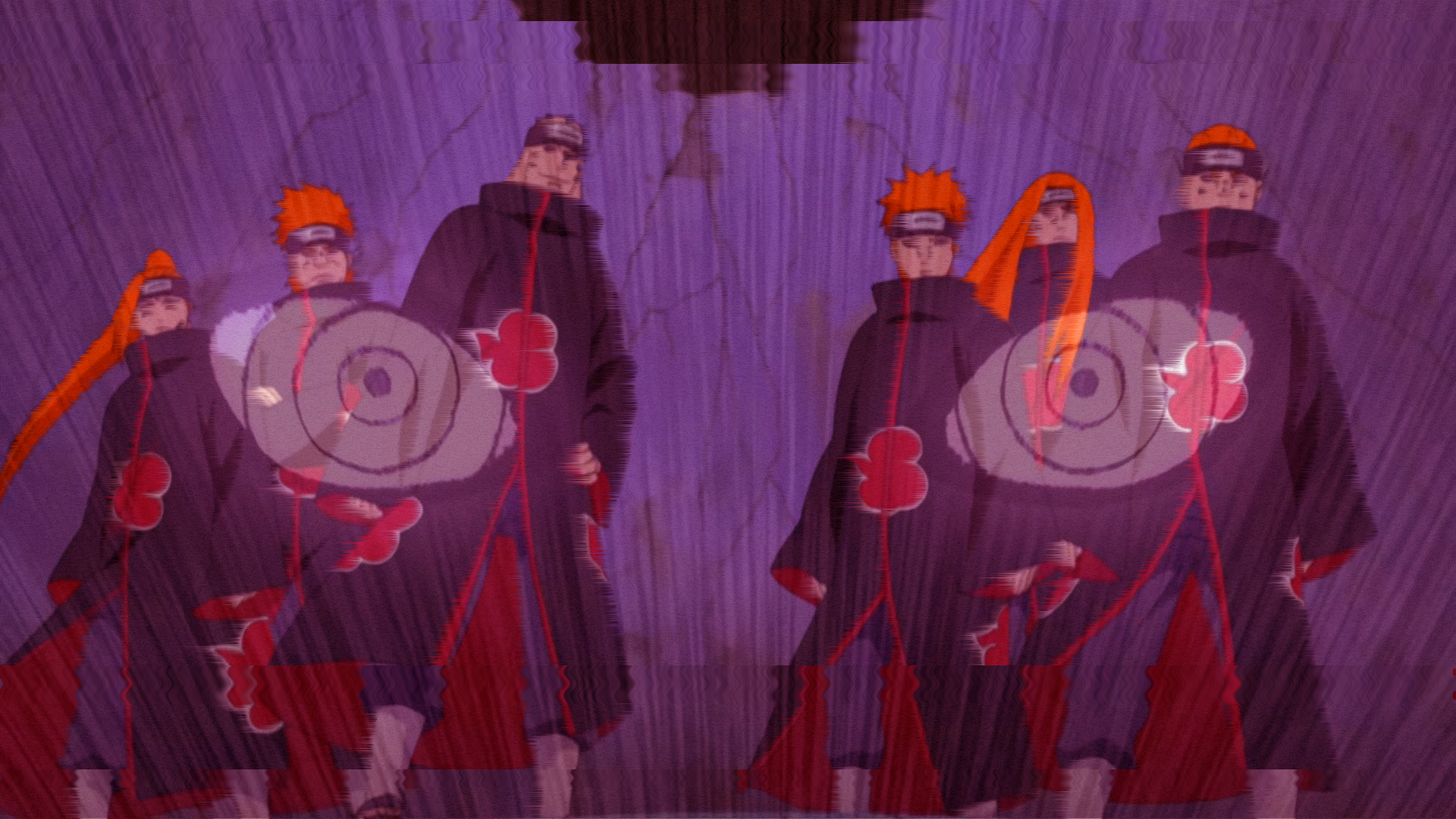
If you’ve spent any time watching Naruto Shippuden, you know that moment when the music shifts. That haunting, orchestral "Girei" theme kicks in, and suddenly, you aren’t just looking at one villain. You’re looking at six. Honestly, the first time the Six Paths of Pain floated over the Hidden Leaf Village, it changed the stakes of the entire series. It wasn't just about power levels anymore. It was about a philosophical nightmare made flesh.
Nagato’s ability to pilot six corpses simultaneously using the Rinnegan is easily one of the most complex tactical setups in anime history. It’s basically a macabre puppet show, but the puppets can level a city. Most people just see them as a group of orange-haired guys with piercings, but there’s a much deeper layer to how they function, where they came from, and why Kishimoto chose these specific designs.
The Mechanics of the Rinnegan’s Greatest Trick
Let’s get into the weeds for a second. How does this even work? Nagato wasn't physically there. He was emaciated, hooked up to a massive mechanical walker that looked more like a torture device than a throne. He used black receivers—those iconic piercings—to transmit his chakra into the bodies. Think of it like a high-bandwidth 5G network for necromancy.
Each body, or "Path," is a vessel for a specific ability of the Rinnegan. They share a visual field. That’s the real kicker. If you’re fighting one, you’re fighting all of them because they see everything from six different angles at once. There are no blind spots. You can’t sneak up on a god.
The Deva Path: The Face of God
The Deva Path (Tendo) is the one everyone remembers. It used the body of Yahiko, Nagato’s childhood friend, which adds a layer of psychological trauma to the whole thing. This Path controls gravity. Shinra Tensei (Almighty Push) and Chibaku Tensei (Planetary Devastation) are the big ones here.
There’s a catch, though. The Deva Path has a five-second cooldown. In a high-speed ninja battle, five seconds is an eternity. Kakashi Hatake almost exploited this during the invasion, proving that even "gods" have a lag time. It’s these tiny, granular details that make the Six Paths of Pain feel like a solvable puzzle rather than just an invincible boss.
Breaking Down the Other Five
While the Deva Path does the heavy lifting in terms of PR, the others are specialized tools.
The Asura Path is weird. It’s basically a cyborg. It can sprout extra limbs, fire missiles, and turn its head into a laser cannon. In a world of magic and martial arts, having a guy who is essentially a Swiss Army knife of ballistic weaponry is jarring. But it works. It provides the raw, explosive firepower that keeps opponents from getting too close.
Then you have the Human Path. This one is terrifying because it doesn't need to hit you hard. It just needs to touch your head. Once it does, it sucks out your soul and reads your mind instantly. It’s the ultimate interrogation tool. No torture, no waiting. Just a hand on the forehead and your life is over.
The Animal Path is the summoner. Instead of blood contracts, it just summons giant, multi-headed dogs, rhinos, and birds that all have Rinnegan eyes too. This Path is the reason the battlefield gets chaotic so fast. If you don't take out the Animal Path early, you're fighting a zoo of immortal monsters.
The Preta Path is the tank. It absorbs ninjutsu. You throw a Rasengan? It eats it. You fire a dragon made of fire? It drinks it like water. This forces opponents into taijutsu (hand-to-hand combat), which is exactly where the shared vision of the six bodies makes things impossible for the average ninja.
Finally, the Naraka Path. This is the medic. It summons the King of Hell. If one of the other Paths gets "killed," the Naraka Path puts them in the King of Hell's mouth, and they come out fully repaired. It’s the ultimate "undo" button.
The Religious Symbolism Most Fans Miss
Masashi Kishimoto didn’t just pull these names out of a hat. The Six Paths of Pain are based on the Six Realms of Rebirth in Buddhist cosmology.
- Deva: The Realm of Bliss/Gods.
- Asura: The Realm of Demi-gods or Warlike demons.
- Human: The Realm of Passion and Enlightenment.
- Animal: The Realm of Servitude and Ignorance.
- Preta: The Realm of Hungry Ghosts (hence the absorption).
- Naraka: The Realm of Hell.
In Buddhism, these are places you are reborn into based on your karma. By naming his weapons after these realms, Nagato was literally positioning himself as the judge of the world. He believed that through "Pain," he could force humanity to transcend this cycle of suffering. It’s incredibly dark when you realize he’s using the bodies of people Jiraiya met during his travels. It wasn't just a tactical choice; it was a middle finger to his former teacher’s optimism.
How to Counter the Six Paths of Pain
If you ever find yourself in a Shonen jump scenario, you need a strategy. Naruto Uzumaki’s fight against Pain is a masterclass in tactical breakdown.
- Isolate them. You cannot win a 6v1 because of the shared vision. Smoke bombs or geographical barriers are essential.
- Target the Naraka Path first. If you don't kill the "healer," the fight never ends. Naruto figured this out and prioritized taking it down so the others stayed dead.
- Exploit the cooldown. Tendo's gravity has a 5-second window. You have to bait the push and then strike with everything you have in that narrow gap.
- Nature Energy. This is the "glitch" in the system. When the Preta Path tried to absorb Naruto's Sage Mode chakra, it couldn't handle the natural energy and turned into a stone toad. Basically, if the enemy is an "absorber," give them something they can't digest.
Why Pain Remains the Best Villain
Modern villains often lack the sheer presence that Pain had. There was a sense of inevitability with him. When he used Shinra Tensei to flatten Konoha, it was a "point of no return" moment for the series.
The tragedy of Nagato is that his Six Paths of Pain were born out of a genuine desire for peace. He wasn't some mustache-twirling bad guy who wanted to rule the world for the sake of it. He was a victim of war who thought the only way to stop the cycle was to become a god-like deterrent. He wanted to create a peace through "mutual assured destruction."
Actionable Takeaways for Superfans
If you're revisiting the series or diving into the lore for the first time, keep these points in mind to appreciate the writing more:
- Watch the eyes. In the anime, notice how the "camera" often cuts to what one of the other Paths is seeing. It’s a great visual cue for their shared vision.
- Check the origins. Research the characters whose bodies became the Paths. Each one was a ninja Jiraiya encountered in his life, usually someone who had a cynical view of the world.
- Analyze the philosophy. Compare Nagato's "Peace through Pain" with Naruto's "Peace through Understanding." It’s the core debate of the entire franchise.
The Six Paths of Pain represent the peak of Naruto's tactical combat. It’s a system where every ability has a cost and every strength has a counter, provided you’re smart enough—or brave enough—to find it.
To truly understand the impact of the Six Paths, re-watch the battle starting at episode 157 of Naruto Shippuden. Pay close attention to the order in which Naruto eliminates each Path. It isn't random. He systematically deconstructs Nagato's defense by removing the support roles first, a strategy that is still studied by fans and writers today as a benchmark for high-stakes action sequences.