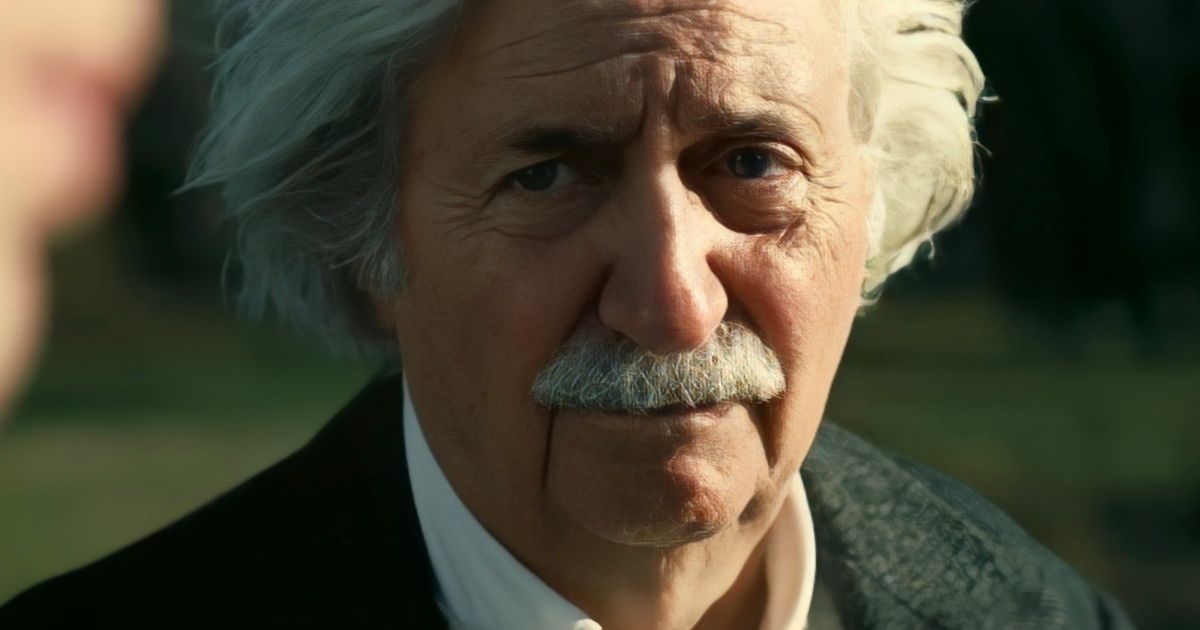
Christopher Nolan’s Oppenheimer isn't just a movie about a big bomb. It’s actually a movie about two men standing by a pond, talking about the end of the world. That final scene—where Cillian Murphy’s J. Robert Oppenheimer leans in to whisper to Tom Conti’s Albert Einstein—has basically become the "What did he say?" moment of the decade. People are obsessed with it.
But here’s the thing.
While the movie is a masterpiece of historical fiction, it blends real history with cinematic flair. To understand what did Oppenheimer say to Einstein, you have to look at two different things: the script written by Nolan and the actual, messy relationship these two geniuses shared at the Institute for Advanced Study in Princeton.
They weren't always "besties." Far from it.
Einstein was the old guard, the guy who revolutionized physics but then spent his later years shaking his head at quantum mechanics. Oppenheimer was the "father of the atomic bomb," a man who was arguably more of a politician and administrator than a pure theoretical visionary in his later career. When they talked, it wasn't just about physics. It was about legacy.
The Cinematic Reveal: "I Believe We Did"
In the film, the mystery of their conversation drives the entire plot. We see the interaction from Lewis Strauss’s perspective early on, but we don't hear the audio. Strauss, played by Robert Downey Jr., thinks Oppenheimer is poisoning Einstein against him. He's convinced they are gossiping. He’s wrong.
The actual dialogue in the film’s final moments is haunting.
Oppenheimer reminds Einstein of a calculation they discussed years earlier—the possibility that a nuclear chain reaction wouldn't stop, that it would ignite the atmosphere and destroy the entire world.
"Albert," Oppenheimer says. "When I came to you with those calculations, we thought we might start a chain reaction that would destroy the entire world."
Einstein looks at him, somber and heavy. "What of it?"
Oppenheimer’s response is the gut-punch of the movie: "I believe we did."
It’s a metaphor, obviously. The atmosphere didn't catch fire in 1945, but the geopolitical world did. They started a nuclear arms race that, in Oppenheimer’s mind, made the eventual destruction of humanity almost a mathematical certainty.
What Actually Happened at Princeton?
Okay, let’s get into the weeds of real history. Did they actually have a dramatic conversation by a pond where they predicted the apocalypse?
Sorta.
Oppenheimer and Einstein were colleagues at Princeton from 1947 until Einstein’s death in 1955. Oppenheimer was the Director of the Institute for Advanced Study. He was Einstein’s boss, which is a weird dynamic to wrap your head around. Imagine being the boss of the most famous person on the planet.
In a 1965 article for The New York Review of Books, Oppenheimer wrote about Einstein with a mix of reverence and brutal honesty. He described Einstein as "entirely without sophistication and entirely without self-importance." But he also basically said Einstein was a bit out of touch with modern physics.
He didn't think Einstein was a "living god." He thought he was a great man who had reached his limit.
The specific "chain reaction" conversation portrayed in the movie actually involved a different physicist: Arthur Compton. In real life, when the Los Alamos team (specifically Edward Teller) realized that a nitrogen-nitrogen fusion reaction might ignite the atmosphere, Oppenheimer didn't run to Einstein. He went to Compton. Einstein wasn't really involved in the day-to-day calculations of the Manhattan Project. He didn't even have a security clearance to see that data.
Why the Movie Version Matters More Than the Fact
You might wonder why Nolan "lied" about who Oppenheimer talked to.
It wasn't a lie; it was a narrative choice. Einstein represents the soul of science. By asking what did Oppenheimer say to Einstein, the audience is really asking: How do these men live with what they’ve done?
Einstein had signed the 1939 letter to FDR urging the development of the bomb because he feared the Nazis would get it first. He later called that the greatest mistake of his life. Oppenheimer, meanwhile, was the one who actually built the thing.
Their real-life conversations were often about the McCarthy-era witch hunts. Einstein actually told Oppenheimer that he should just "walk away" from the government. He told him that if the United States wanted to put him on trial and revoke his security clearance after everything he’d done, he should just quit and leave.
Oppenheimer couldn't do it. He loved being an insider. He loved the power.
Einstein reportedly walked into his office after Oppenheimer left a meeting and told his secretary, "There goes a narr" (the Yiddish/German word for fool).
The Weight of the "Destroyer of Worlds"
We all know the famous quote from the Bhagavad Gita: "Now I am become Death, the destroyer of worlds." Oppenheimer claimed he thought of that during the Trinity Test.
But the conversation with Einstein hits differently because it's about the future, not the moment of detonation. When people search for what did Oppenheimer say to Einstein, they are looking for the moment of realization.
It's the realization that you can't put the genie back in the bottle.
The film captures a truth that isn't in the archives. It captures the psychological weight of the 20th century. By the 1950s, both men were essentially symbols. Einstein was the symbol of peace and pure thought; Oppenheimer was the symbol of the military-industrial complex and the "troubled" scientist.
They were two sides of the same coin.
If you look at the real letters between them, they are mostly professional. But there is an underlying sense of shared burden. They were the only two people who truly understood what it felt like to change the fundamental nature of reality and then realize the world wasn't ready for it.
Actionable Insights: How to Fact-Check Historical Films
If you're a history buff or just someone who hates being "lied to" by Hollywood, here’s how you can dig deeper into the real Oppenheimer/Einstein dynamic:
- Read "American Prometheus": This is the biography the movie is based on. It’s thick, it’s dense, but it is the gold standard for facts. It details every single meeting they had.
- Check the Princeton Archives: The Institute for Advanced Study has digitized a lot of correspondence. You can actually see the memos Oppenheimer wrote about Einstein’s office space and salary.
- Distinguish between "Historical Truth" and "Emotional Truth": Christopher Nolan often prioritizes emotional truth. The pond scene is emotionally true—it represents the shift in their relationship—even if the specific dialogue was written in 2022.
- Look at the Compton Connection: If you want to be the smartest person in the room, tell people that the "chain reaction" scare actually happened at a vacation house in Michigan with Arthur Compton, not a pond in Princeton with Einstein.
The legacy of these two men isn't just in the bombs we have today. It's in the way we think about the responsibility of being smart. When Oppenheimer told Einstein that they had started a chain reaction that destroyed the world, he wasn't talking about fire. He was talking about us. He was talking about the fact that we are still living in the shadow of that conversation.
To really grasp the gravity of their relationship, start by looking at Oppenheimer's 1965 speech at UNESCO. He speaks about the "shame" of the scientist and the "glory" of the discovery. It's the most honest he ever was about the trade-off he made. Einstein, by that point, had been dead for a decade, but his influence is all over Oppenheimer's words. They were never just colleagues. They were the architects of the modern age, and they both knew it was built on a very shaky foundation.