Let's be honest for a second. If you close your eyes and picture Marty McFly sliding across the pavement in 1985, you probably see a pair of Back to the Future Air Jordans on his feet. It makes sense. Nike is basically the third lead actor in that franchise. But here is the kicker: Marty McFly never actually wore Air Jordans.
Wait. What?
Seriously. Go back and watch the tapes. In the original 1985 masterpiece, Michael J. Fox is rocking the Nike Bruin. It’s a low-profile, white leather basketball shoe with a red swoosh. Simple. Classic. But definitely not a Jordan. Yet, if you search the internet today, thousands of people are hunting for "Back to the Future Air Jordans" like they’re the Holy Grail of cinema history. This is a classic case of the Mandela Effect meeting sneakerhead culture, and it has created a massive market for shoes that technically don't exist—at least not in the way the movies portrayed them.
The confusion isn't totally random, though. We’ve spent decades watching the Nike Mag—the self-lacing "hoverboard shoe"—dominate the conversation. Because the Mag looks like a high-tech space boot, our brains naturally group it with the most famous high-top of that era: the Air Jordan 1.
The Shoe That Wasn't There: Debunking the Jordan Myth
It is kinda wild how memory works. We see a red and white Nike on a 1980s icon and we just assume it’s a Jordan 1 "Chicago." But back in '85, Nike was just starting to figure out how to put their logo on the silver screen. Tinker Hatfield hadn't even designed the Mag yet.
The Nike Bruin Marty wore was actually a bit of a relic even then. It was one of the first low-cut basketball shoes Nike ever produced, debuting in the early 70s. By the time Back to the Future started filming, Nike was desperate to push their new "Air" technology, but the production team stuck with the Bruin because it felt more "everyman." It felt like something a kid from Hill Valley would actually own.
Why the mix-up matters
Sneaker culture is built on narratives. If you tell a story well enough, the shoe becomes a legend. Because the movie is so intrinsically tied to "cool" and "the future," people naturally want the most "cool" shoe of that era to be the one in the film.
- The Air Jordan 1 launched the same year as the movie.
- Both shoes feature a heavy red-and-white color palette.
- Michael J. Fox and Michael Jordan were the two biggest "Michaels" on the planet in 1985.
When you mash those things together in a blender of 80s nostalgia, you get a persistent myth. You get people walking into vintage shops asking for Back to the Future Air Jordans. They don't want the Bruin. The Bruin is a tennis shoe. They want the heat. They want the high-tops.
Enter the Nike Mag: The Real "Future" Shoe
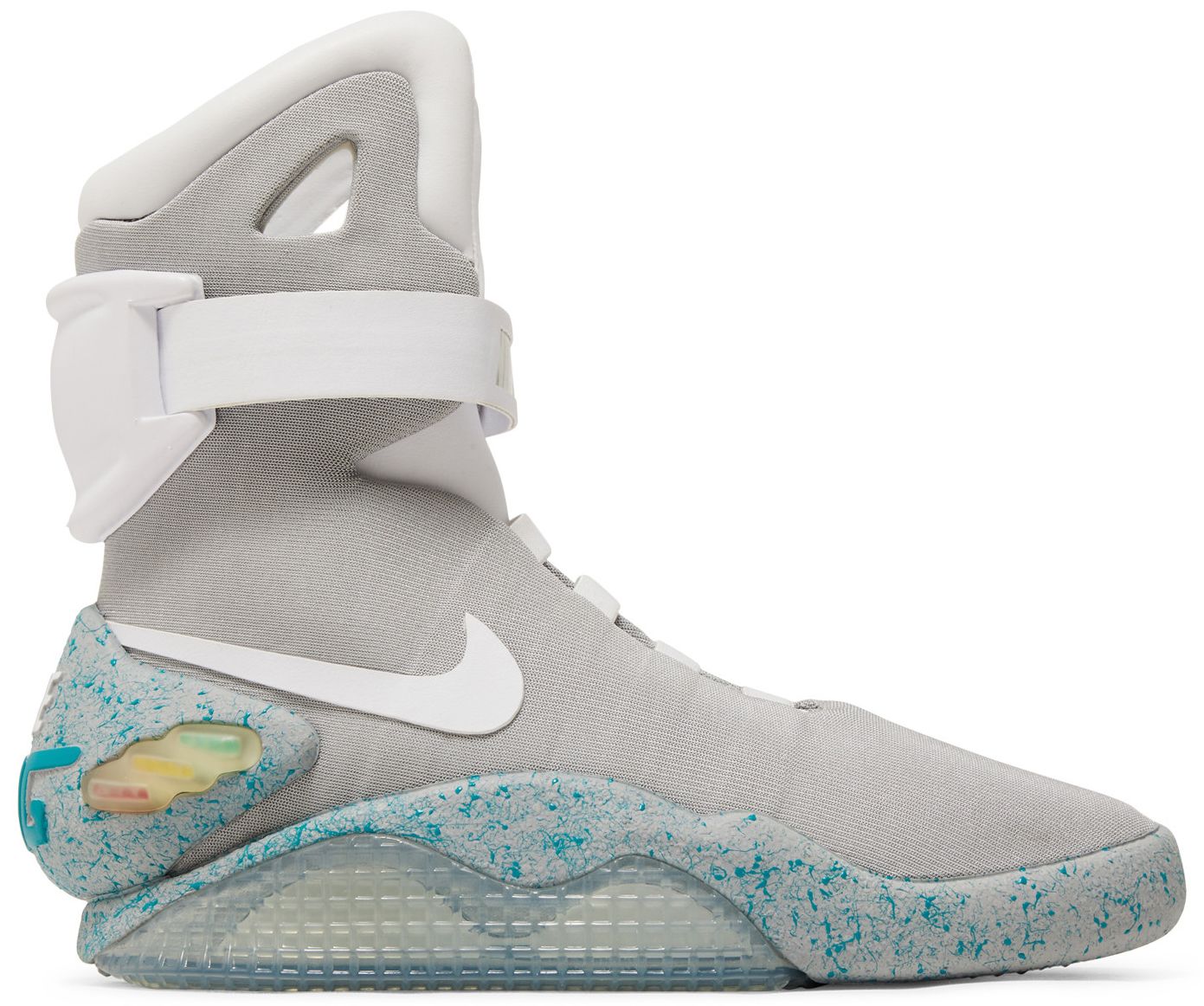
If we are talking about the "real" Back to the Future shoes, we have to talk about the Nike Mag. This is where things get interesting for collectors. In Back to the Future Part II, Marty travels to the distant, far-off year of 2015. There, he finds a pair of Nikes that lace themselves.
These weren't Jordans either. They were a total fever dream from the mind of Tinker Hatfield.
Hatfield is the guy who designed almost every iconic Jordan you love—the 3, the 4, the 11. So, in a way, the Nike Mag shares the same DNA as an Air Jordan. It has that same architectural soul. But the Mag was never meant to be a retail product. It was a prop. It was a hunk of foam, some lights, and a battery pack hidden in Michael J. Fox’s backpack with a guy under the stage pulling wires to simulate the "power laces."
The 2011 and 2016 Releases
Nike eventually realized they couldn't just leave that itch unscratched. In 2011, they dropped 1,500 pairs of the Nike Mag via eBay auctions to benefit the Michael J. Fox Foundation for Parkinson's Research. They didn't have power laces yet, but they looked the part.
Then came 2015—the actual year from the movie.
Nike teased it. The world went nuts. In 2016, they finally released the "Auto-Lace" version. Only 89 pairs existed. They were distributed via a digital lottery, and the prices today are astronomical. We are talking $50,000 to $100,000 depending on the day.
Custom Culture: When Fans Make Their Own Back to the Future Air Jordans
Since most of us don't have $60k lying around for a pair of light-up boots, the community did what it does best: it started modding. This is where the term Back to the Future Air Jordans actually becomes a reality.
Customizers took the Air Jordan 1 and gave it the "Mag" treatment. They used grey leather, blue speckled midsoles, and transparent outsoles. They even added LED lights to the heels.
Honestly, some of these look better than the movie props. There’s something about the silhouette of a Jordan 1 painted in that "Wolf Grey" and "Light Blue" colorway that just hits right. It bridges the gap between the greatest basketball shoe ever made and the greatest sci-fi movie ever made.
Popular Base Models for Customs
People aren't just using the Jordan 1. I’ve seen some incredible work on:
- Air Jordan 4s: The plastic "wings" on the side make it look a bit more industrial and "future-y."
- Air Jordan 6s: This is a popular choice because the 6 already has a bit of a space-boot vibe with the translucent sole and the toggle lacing system.
- Nike Adapt BB: While not a Jordan, this was Nike's first real attempt at bringing the Mag's auto-lacing tech to a performance basketball shoe. If you see a "Mag" colorway on an Adapt, that’s basically the modern spiritual successor to what Marty was wearing.
The Nike Dunk "Back to the Future" Connection
There is one more shoe that adds to the confusion: the Nike SB Dunk Low "Marty McFly."
Released in 2015, this was an official Nike release under the Skateboarding line. It used the exact color scheme of the Nike Mag—matte grey upper, white swoosh, and a turquoise speckled midsole that mimics the lights on the Mag's heel.
Because the Dunk and the Jordan 1 share a nearly identical outsole and very similar paneling, many casual fans see this shoe and label it a "Back to the Future Jordan." It's an easy mistake to make. It’s also probably the closest most people will ever get to owning a piece of the movie's legacy without selling a kidney.
Why the Obsession Persists
Why do we care so much? It’s just leather and rubber, right?
Nah. It's about what the shoes represent. Back to the Future was one of the first times a brand didn't just pay for a logo to be on screen; they actually helped build the world. The shoes were a plot point. They were a signifier of the time Marty was in.
When people look for Back to the Future Air Jordans, they are looking for that feeling of being a kid again, seeing those laces tighten for the first time. They’re looking for the intersection of 80s grit and 2015 optimism.
Even though Michael Jordan never wore the Mags and Marty McFly never wore the Jordans, the two brands are permanently fused in our collective pop-culture consciousness. They both represent the pinnacle of "cool" from a decade that refuses to die.
Fact Check: What did the cast actually wear?
- Marty McFly: Nike Bruin (1985), Nike Mag (2015), Converse All-Star (1955), Black Cowboy Boots (1885).
- Biff Tannen: Usually some form of generic black boot or athletic trainer, though in the "future" 2015, his gang wore some pretty wild custom footwear that looked like proto-cyberpunk gear.
- Doc Brown: He actually wore Nike Vandals in some scenes. The Vandal is another high-top with a strap that looks remarkably like a Jordan, which only adds to the "Wait, was that a Jordan?" confusion.
How to Get the Look Today
If you’re dead set on owning a pair of Back to the Future Air Jordans, you have a few realistic paths. You aren't going to find them at a Foot Locker, but you can definitely find them if you know where to look.
The "Poor Man's Mag" (Nike SB Dunk Low)
Look for the "McFly" SB Dunk on sites like StockX or GOAT. Prices have climbed over the years, but they are still in the "expensive sneaker" range rather than the "buy a new car" range. They give you the vibe without the bulk.
The Custom Route
Find a reputable sneaker customizer on Instagram (look for artists who specialize in "decon-recon"). You can send them a pair of plain white or grey Air Jordan 1s and have them apply the Mag colorway. This is actually the most "authentic" way to get a Jordan version of the shoe, as Nike has never officially released a Jordan 1 x Back to the Future crossover.
The Nike Adapt Line
If you want the tech, not just the colors, look at the Nike Adapt BB 2.0 "Mag." It has the auto-lacing motor, it connects to your phone, and it uses the exact light-blue and grey palette from the film. It’s a chunky shoe, but it’s the closest thing to "the future" that actually works for everyday wear.
Identifying Fakes and "Replica" Mags
Because the demand is so high and the supply is so low, the market is flooded with fakes. You’ll see "Back to the Future Air Jordans" advertised on sketchy websites for $150.
Here is the reality: Nike has never made a shoe with that name.
If you see a Jordan 1 with "Air Mag" lights on it for a cheap price, it's a knock-off from a factory that doesn't care about quality or safety. The electronics in those cheap fakes are notorious for overheating. If you want the look, buy a real pair of grey Jordans and appreciate them for what they are.
Practical Steps for Collectors
If you are starting your search now, don't just type "Back to the Future Air Jordans" into Google and click the first link. You’ll end up on a scam site.
Instead, search for the Nike Bruin "Marty McFly" (released in 2015 for the 30th anniversary) if you want the actual shoe from the first movie. It’s a beautiful, understated sneaker that goes with everything.
If you want the "Future" look, search for the Nike Adapt BB 2.0 Mag. It’s the most functional version of the technology ever released.
Finally, if you just love the Jordan silhouette, look for the Air Jordan 1 "Stealth" or "Wolf Grey." They provide a clean, neutral base that captures the aesthetic of the Mag without being a literal costume piece.
The "Back to the Future Jordan" might be a myth, but the culture it created is very real. It’s a reminder that sometimes, the stories we tell ourselves about our favorite movies are just as powerful as the movies themselves.
Check the serial numbers and the stitching before you drop any serious cash on the secondary market. A "deal" on Mags or limited Dunks is almost always too good to be true. Stick to verified marketplaces and always ask for tagged photos if you’re buying from individual collectors on forums. Clearer heads—and clearer authentications—always win in the sneaker game.