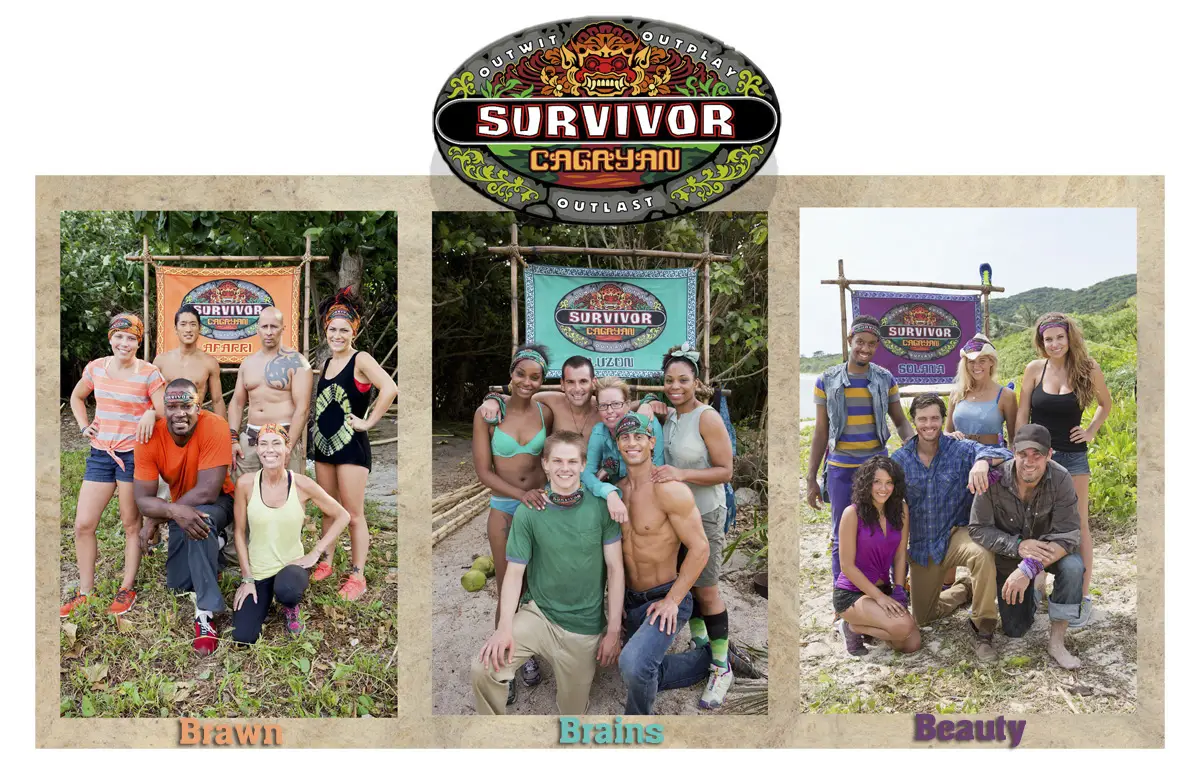
Twenty-eight seasons in. That’s how long it took for Jeff Probst and the Survivor casting team to stumble onto a gold mine that basically saved the franchise from becoming a stale, repetitive relic of early 2000s television. When Survivor: Cagayan—formally titled Beauty Brains and Brawn Survivor—hit screens in 2014, nobody expected it to be the gold standard. We had just come off a string of "Returning Player" seasons where the newbies were basically lambs to the slaughter.
Then came the Luzon, Solana, and Aparri tribes.
It was a social experiment that felt more like a powder keg. By splitting eighteen strangers based on their primary perceived attribute—be it their looks, their IQ, or their physical grit—the show forced people into boxes they desperately wanted to climb out of. Or, in the case of the Brains tribe, boxes they decided to set on fire and throw into the ocean. Honestly, if you haven't seen J'Tia Taylor dump a bag of rice into a fire while her tribe looked on in a mix of horror and catatonic exhaustion, have you even lived?
The Brains Tribe Was a Beautiful Disaster
Usually, when you put a bunch of high-IQ individuals together, you expect a Masterclass in strategy. You expect 4D chess. Instead, the Luzon tribe (Brains) gave us a lesson in how ego and social ineptitude can tank a group faster than a literal sinking ship.
Garrett Adelstein, a world-class poker player, tried to ban side conversations. That went about as well as you’d think. David Samson, a high-level sports executive, tried to overplay from minute one and got sent packing first. It was a mess. But within that mess, we found the strategic core that would define modern Survivor. Spencer Bledsoe and Kass McQueen.
Spencer was the underdog we all rooted for, the "kid" who seemed to have a better grasp on the game than people twice his age. Then you had "Chaos Kass." Whether you love her or hate her, Kass McQueen redefined what it meant to play a "flipping" game. Her move at the merge—flipping on her alliance to vote out Sarah Lacina—is still debated in fan circles today. Was it a winning move? Probably not. Was it iconic television that proved the Beauty Brains and Brawn Survivor format could produce high-stakes drama? Absolutely.
Tony Vlachos and the Brawn Dominance
You can't talk about this season without talking about the guy who literally ran circles around everyone else. Tony Vlachos.
The man is a police officer from Jersey who decided that the best way to win a million dollars was to build a "Spy Shack" made of bamboo and palm fronds. It sounds ridiculous. It was ridiculous. But it worked. Tony played with a level of kinetic energy that we hadn't seen since Russell Hantz, but with one major difference: Tony actually had a social game. He would blindside his closest allies, apologize, and then somehow convince them to vote with him again the next night.
The Brawn tribe (Aparri) wasn't just about muscles, though. It introduced us to Sarah Lacina, who would eventually go on to win Game Changers. The dynamic between Sarah and Tony—the "Cops 'R' Us" alliance—is arguably the most important relationship in the last decade of the show. It started here. It started with the premise that "Brawn" meant more than just lifting heavy things; it meant a certain kind of blue-collar work ethic and a "ride or die" mentality that, ironically, led to some of the most complex betrayals in the show's history.
The Underestimated "Beauty" Tribe
People always sleep on the Beauty tribe. It’s the "filler" category, right? Wrong.
Solana gave us Morgan McLeod, who was refreshingly honest about using her looks as a weapon. But more importantly, it gave us Bryce Isaiah and LJ McKanas. While the Brains were busy self-destructing, the Beauty tribe was actually playing a relatively nuanced game of social positioning.
The problem with the "Beauty" label is that it often masks the "Brains" underneath. Look at Alexis Maxwell or LJ; these weren't just pretty faces. They were students of the game who got caught in the crossfire of a chaotic merge. The Beauty Brains and Brawn Survivor twist worked because it created a chip on everyone's shoulder. The "Beauties" wanted to prove they were smart. The "Brains" wanted to prove they were tough. The "Brawns" wanted to prove they were strategic.
Why the "Special" Idol Changed Everything
We have to mention the "Tyler Perry Idol." This was a super-idol that could be played after the votes were read. In any other season, this might have ruined the tension. But in the hands of Tony Vlachos, it became a tool of psychological warfare. He didn't even have to use it. He just had to let people know he had it.
This season taught future players that information is more valuable than the advantage itself. Tony lied about the idol's powers, claiming it could be used much later in the game than it actually could. He weaponized a piece of plastic and turned it into a shield that carried him all the way to the Final Two.
The Legacy of the Final Two
Cagayan was one of the last times we saw a Final Two instead of a Final Three. This led to one of the most shocking decisions in reality TV history.
Woo Hwang won the final immunity challenge. He had a choice:
- Take Kass McQueen to the end and almost certainly win the million dollars because the jury disliked her.
- Take Tony Vlachos, his "brother" in the game, and risk losing to a superior strategist.
Woo chose "honor" over "money." He took Tony.
Tony won in a landslide.
This moment cemented the Beauty Brains and Brawn Survivor season as a tragedy for Woo but a triumph for the "Big Moves" era. It signaled to every future player that if you want to win, you cannot play with your heart. You have to play with your head.
How to Apply "Cagayan" Logic to Modern Survivor
If you’re a fan looking to understand why the show looks the way it does now, you have to look at the "Cagayan" blueprint. It moved away from the "pagonging" (where one alliance just systematically votes out the other) and toward "voting blocks."
- Trust No One, But Use Everyone: Tony’s game showed that you can flip on an ally at 9, and bring them back at 7.
- The Spy Shack Mentality: Always be listening. Information is the only currency that matters.
- Embrace the Chaos: If you are on the bottom, like Spencer was for 80% of the game, your only hope is to create friction between the people on top.
The 28th season wasn't just a gimmick. It was a reset. It proved that you don't need returning legends to make a legendary season. You just need a group of people who are willing to play hard, fail spectacularly, and leave their egos at the door—or, in the case of the Brains tribe, let their egos burn the camp down.
For anyone looking to truly master the strategy of the game, re-watching the Beauty Brains and Brawn Survivor is non-negotiable. Pay attention to the social cues Tony uses to disarm people. Watch how Sarah Lacina reads people’s lies. Study how Spencer survives when he should have been dead in the water on Day 6.
The real takeaway? Labels don't define you in the game, but they definitely define how people perceive you. The smartest players are the ones who know exactly which "box" they've been put in and use that to hide their true intentions until it's too late for everyone else.
To get the most out of your next Survivor rewatch or if you're preparing for a local "Living Room Survivor" game, focus on the "Information Gap." The winner of Cagayan didn't just have better physical skills; he had better intel. Track who talks to whom after every challenge. Usually, the person doing the least talking in a large group is the one doing the most damage in private.
Actionable Insights for Survivor Fans:
- Analyze the Edit: In Cagayan, the winner was visible from episode one. If you're watching a new season, look for the person whose "mistakes" are being explained away by the narrator.
- The Social Map: Draw a literal map of alliances during the merge. You'll notice that the "Brawn" winners usually occupy the center of the web, not the edges.
- Study the Jury: Tony won because he owned his game. If you ever play a social strategy game, never apologize for a blindside—explain it as a necessity. Jury members respect a move, but they hate a "sorry" player.