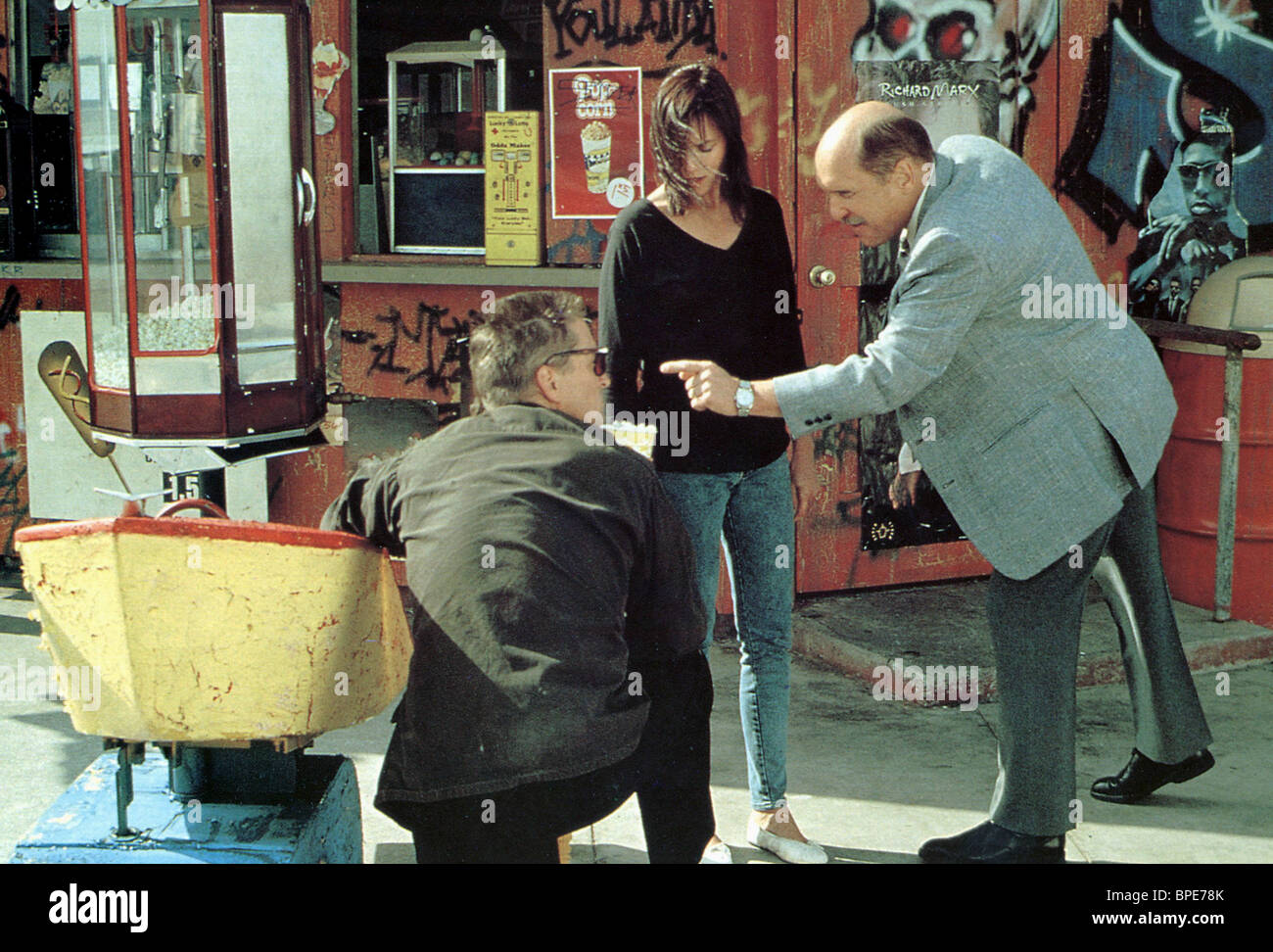
It’s a sweltering day in Los Angeles. Traffic is a graveyard of idling engines and frayed nerves. Most people remember Falling Down for Michael Douglas’s flat-top haircut and his legendary meltdown over a stale breakfast sandwich. But the real heartbeat of that 1993 classic isn't the guy with the rocket launcher. It's the tired guy in the desk chair. Robert Duvall falling down the rabbit hole of an investigation on his very last day as a cop is what actually grounds the film in reality.
Honestly, it’s one of the most underrated performances of Duvall’s massive career. While Douglas is out there smashing up convenience stores with a baseball bat, Duvall plays Sergeant Martin Prendergast with a quiet, simmering dignity. He’s the "before" picture to Douglas’s "after." He’s got plenty of reasons to snap—a grieving, overbearing wife, a boss who treats him like a furniture piece, and a precinct that thinks he’s lost his edge. Yet, he doesn’t pick up a Uzi. He just does his job.
The Quiet Brilliance of Prendergast
Most "last day on the job" movies are clichés. You know the drill: the cop is one day from retirement, and suddenly he’s in a high-speed chase. But Joel Schumacher’s Falling Down subverts that. Prendergast isn’t some action hero. He’s a robbery detective who’s been relegated to a desk because he got shot once and his wife, Amanda (played with heartbreaking fragility by Tuesday Weld), can’t handle the stress of him being on the street.
The magic of Duvall’s performance is in the details. The way he adjusts his glasses. The way he takes the verbal abuse from his younger, more arrogant colleagues with a weary smile. He’s a man who has been "economically viable" his whole life but is being pushed out into a world he doesn't recognize.
You see, Robert Duvall falling down the path of this case is the only thing that gives the movie its moral compass. Without him, the film is just a nihilistic romp through a crumbling city. With him, it’s a study of two men facing the same decay and choosing different exits.
A Study in Contrast
Think about the scenes. Douglas (William "D-Fens" Foster) is reacting to the "little things"—the price of a soda, the lack of breakfast at 11:31 AM, the construction that never ends.
Prendergast is dealing with the big things. He’s dealing with the death of his daughter (SIDS) and the slow erosion of his own self-worth. There's a scene where he’s on the phone with his wife, and she’s spiraling about a dinner he’s supposed to attend. He’s patient. He’s kind. He’s hurting, but he doesn't make it everyone else's problem.
That’s the nuance people miss. The movie isn't just about a guy who had a bad day; it’s about the choice to remain human when the world stops treating you like one.
Why the Ending Still Hits So Hard
The final showdown on the Venice Pier is cinematic perfection. No explosions. No choreographed martial arts. Just two tired men.
When D-Fens asks that famous question—"Am I the bad guy?"—it’s Prendergast who has to deliver the truth. Duvall’s delivery is perfect. He doesn't say it with hate. He says it with a sort of pity. He recognizes that they are, in many ways, the same person. They both feel obsolete. They both feel like the world moved on without them.
The "London Bridge" Connection
The title isn't just a metaphor for a nervous breakdown. It’s a literal nursery rhyme referenced in the film. "London Bridge is falling down."
- Prendergast’s life is falling down around his ears because of his wife’s mental health.
- D-Fens’s life fell down when he lost his job and his family.
- Los Angeles itself is falling down, depicted as a sweaty, graffiti-covered purgatory.
Duvall brings a sense of "old school" stability to this chaos. He’s the only person who actually listens to the victims D-Fens leaves in his wake. While the other cops are laughing at the "crazy guy" stories, Prendergast is the one connecting the dots. He sees the pattern because he feels the same heat.
The Robert Duvall Masterclass
If you watch the movie again, pay attention to Duvall’s eyes in the precinct scenes. He’s a background character for the first third of the film, but he dominates every frame he’s in. He’s playing a man who is being forced to say goodbye to the only thing that gives him a sense of identity—his badge.
Kinda makes you think about how we treat older professionals today, doesn't it? The "out with the old, in with the new" mentality that leaves people like Prendergast feeling like they’re just taking up space.
But at the end of the movie, Prendergast doesn't retire. Or rather, he decides he’s not done yet. He tells his jerk of a captain to "Go f*** himself" in front of the cameras. It’s the most cathartic moment in the film because it’s a healthy release of anger, unlike the trail of bodies D-Fens left behind.
Actionable Insights for Fans of the Film
If you're looking to revisit this 90s staple or want to understand Duvall's role better, here's how to approach it:
- Watch for the Parallelism: Notice how every time D-Fens encounters a "villain" (the neo-Nazi, the gang members), Prendergast is usually one step behind, dealing with a bureaucratic "villain" (his boss, the system).
- Focus on the Sound Design: The movie uses sound—buzzing flies, sirens, clicking pens—to show the sensory overload both men are feeling.
- Check out Duvall’s 90s Run: This was a peak era for him. Compare his role here to his work in A Civil Action or The Apostle. He has this incredible ability to play "the everyman" with a hidden reservoir of steel.
Falling Down remains a controversial film. Some people see D-Fens as a hero of the frustrated middle class. Others see him as a domestic terrorist in a tie. But everyone agrees that Robert Duvall’s Prendergast is the anchor. He’s the reminder that even when the bridge is falling down, you don't have to jump off it.
You just have to keep walking, do your job, and maybe, if you're lucky, tell your boss exactly what you think of him before you head home for dinner.
To truly appreciate the film, look past the "Whammy Burger" scene. Look at the guy who didn't pull the trigger until he absolutely had to. That’s where the real story is.
If you want to dive deeper into 90s cinema, look for the original shooting script by Ebbe Roe Smith. It highlights even more of the intended parallels between the two lead characters that didn't quite make the final cut. You'll find that the "falling down" was always meant to be a shared experience between the cop and the criminal.