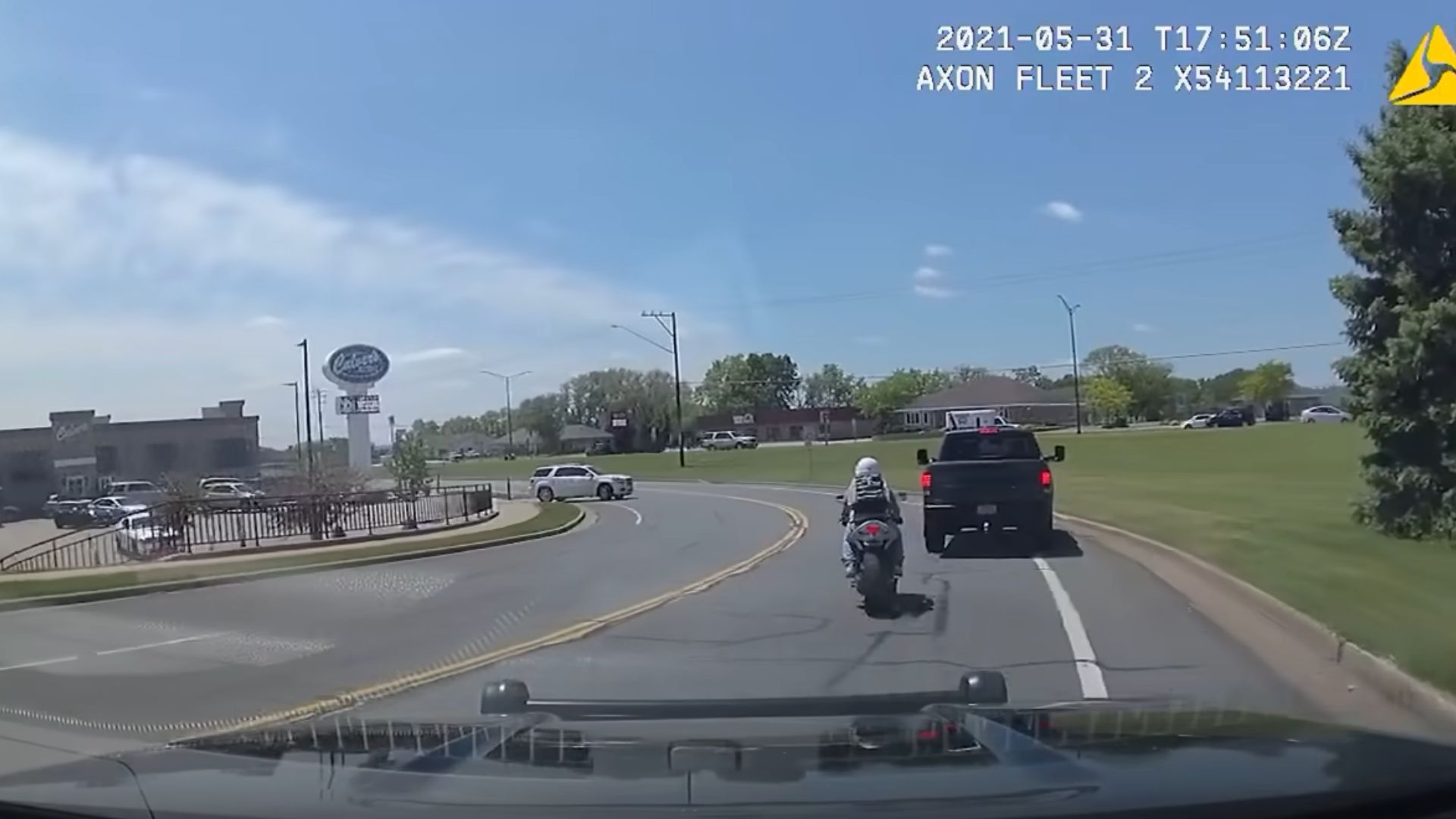
The sound of a liter bike screaming at 14,000 RPM is unmistakable. It’s a mechanical howl that echoes off highway barriers, usually followed seconds later by the discordant wail of a police siren. If you spend enough time on motorcycle forums or watching raw helmet-cam footage on YouTube, you’ll see it eventually. A rider looks in their mirror, sees the red and blues, and makes a split-second decision to drop two gears and vanish. Motorcycle running from cops isn't just a trope in action movies; it’s a dangerous, real-world phenomenon that law enforcement agencies are getting increasingly efficient at shutting down.
Most people think it’s a simple game of speed. It isn’t. You might have a bike that does 180 mph, but you can’t outrun a radio wave or a thermal camera mounted to a helicopter.
The Reality of the Pursuit
Police departments across the country, from the California Highway Patrol to the NYPD, have shifted their tactics significantly over the last decade. Back in the day, a "no-chase" policy was a rider's best friend. Departments realized that chasing a bike through city streets often caused more collateral damage than the initial speeding ticket was worth. But don't mistake a lack of a physical chase for getting away.
Modern policing uses "tactical disengagement." This basically means the officer on the ground might pull over and turn off their lights, but a "star chase" or a drone is already tracking your heat signature from 2,000 feet up. Drones like the DJI Matrice 300 RTK are now standard issue for many urban units. They can track a bike through dense traffic without the rider even knowing they are being watched. By the time you pull into your garage or a "hidden" parking lot, the police are already three blocks away, coordinating a quiet surround.
Physics Always Wins
Let's talk about the math for a second. Even if you’re a track-day hero, the street is not a controlled environment. A patch of gravel, a distracted driver changing lanes without a blinker, or a simple "target fixation" error at 130 mph usually ends in a LifeFlight helicopter ride or a trip to the morgue. According to data from the National Highway Traffic Safety Administration (NHTSA), motorcyclists are already significantly overrepresented in traffic fatalities. When you add the adrenaline of a pursuit, your peripheral vision narrows—a phenomenon known as "tunnel vision"—and your ability to process complex hazards drops to almost zero.
Technology vs. The Throttle
It’s a common myth that "flipping your plate" or using a "tuck" makes you invisible. Modern automated license plate readers (ALPR) are terrifyingly fast. They can capture plates even at extreme angles or high speeds. Furthermore, "community policing" has gone digital. Police departments now routinely scour social media. If you post a video of your "escape" on TikTok or Instagram, even with your face covered, investigators can often identify the bike by specific aftermarket parts, unique helmet scuffs, or even the GPS metadata embedded in the upload.
The legal fallout is rarely worth the $150 speeding ticket you were trying to avoid. In many states, motorcycle running from cops is classified as "Felony Fleeing and Eluding."
Consider these consequences:
- Your bike is almost certainly going to be impounded and, in some jurisdictions, civilly forfeited (meaning the state sells it and keeps the money).
- You’re looking at a permanent criminal record that will kill 90% of job opportunities in the corporate world.
- Insurance? Forget about it. Your premiums will skyrocket, or you’ll be blacklisted by every major carrier.
The Myth of the "Clean Getaway"
There’s this romanticized version of the getaway where the rider hits a dirt trail or weaves through a narrow alleyway where a cruiser can't fit. While that might work once in a blue moon, the statistical reality is grim. Most riders who run end up crashing. If they don't crash, they get caught because they return to the same areas where they were first spotted.
Police also use "DNA marking" sprays or "StarChase" GPS projectiles in some regions. These are small GPS trackers fired from the grille of a police car that stick to your bike. You might think you’ve lost them, but you’re literally broadcasting your exact coordinates to the precinct dispatch.
What to Do If You're Pulled Over
Honestly, just pull over. It sounds boring, but the alternative is life-altering. Most cops are actually willing to give a warning or a reduced citation to a rider who behaves respectfully and doesn't put the public at risk. If you have a legitimate issue—maybe your registration is expired or you don't have a motorcycle endorsement—a lawyer can fight that in court. You can't fight a felony eluding charge nearly as easily.
The Tactical Approach to Compliance
- Signal early and find a safe, flat spot to stop.
- Turn off the engine and remove your helmet immediately. This shows you aren't planning to bolt.
- Keep your hands visible. Officers are naturally on edge during motorcycle stops because of how easy it is for a bike to disappear.
- Be polite but don't admit to a specific speed. "I'm not sure, Officer," is a valid answer.
Actionable Next Steps
If you feel the urge to push your bike to its limits, the street is the worst place to do it. The risks of motorcycle running from cops outweigh the temporary rush of adrenaline every single time.
- Find a Local Track Day: Organizations like Sportbike Track Time or the California Superbike School provide a controlled environment where you can go faster than you ever could on a highway, with an ambulance 30 seconds away and no one coming the other direction.
- Check Your Legal Status: If you’ve been riding without an endorsement or insurance, fix it today. Most of the reason people run is "paperwork" fear. Eliminating that fear removes the impulse to flee.
- Invest in Training: High-speed skills are best learned from professionals, not from trying to escape a Crown Vic or an Interceptor Utility. Total Control or MSF Advanced courses will make you a better rider than any street chase ever will.
- Review Local Laws: Look up your state’s specific penalties for "Fleeing and Eluding." Seeing the mandatory jail time in black and white is usually enough to make anyone think twice before twisting the grip.
The goal is to keep riding for the next forty years, not to have your story end on a highway off-ramp because of a bad decision made in five seconds.