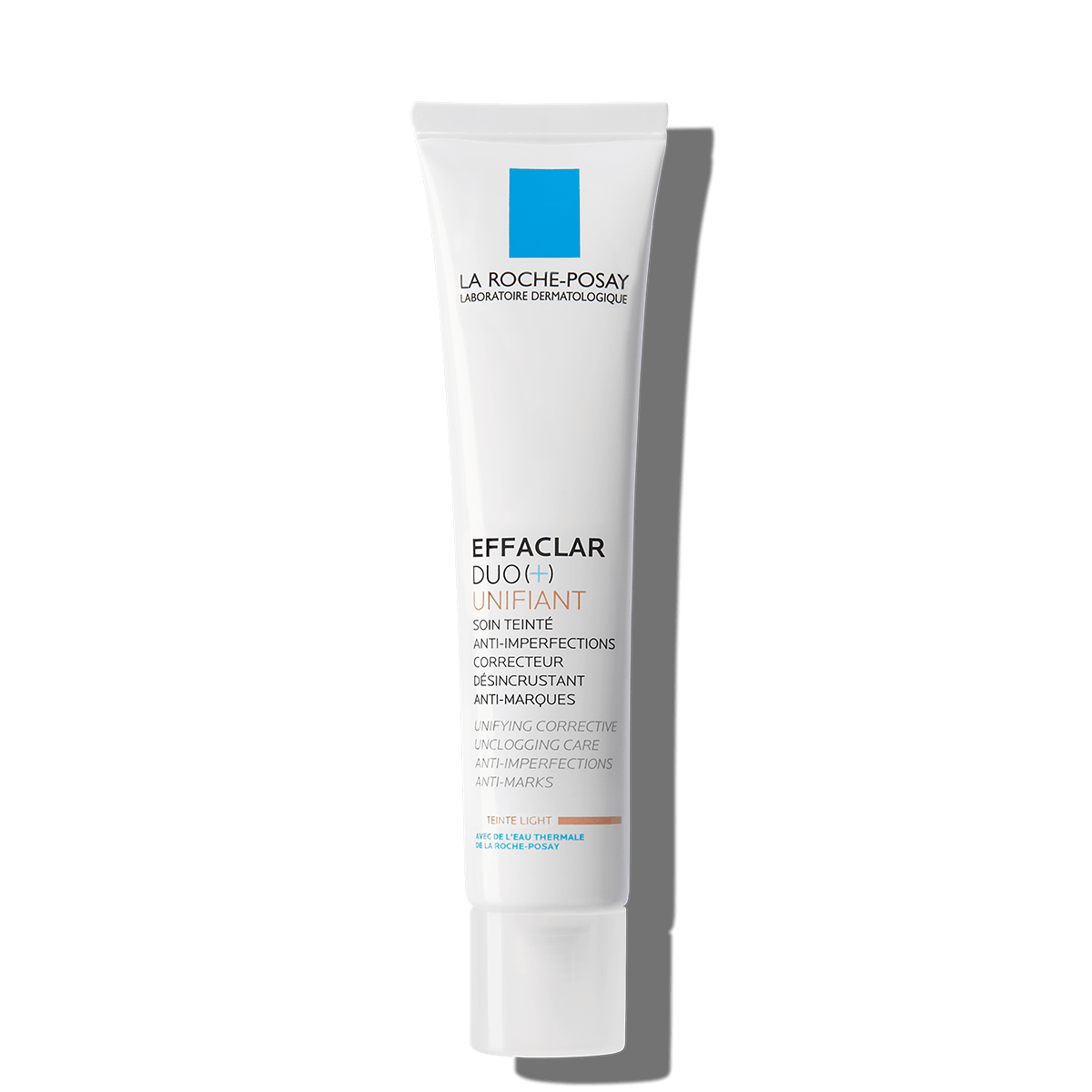
If you've spent more than five minutes scrolling through skincare TikTok or lurking on r/SkincareAddiction, you’ve seen that iconic white and blue tube. It’s everywhere. People treat La Roche Posay Effaclar Duo Plus like it’s holy water for the acne-prone. But here’s the thing—half the people who buy it end up hating it within a week because their face starts peeling off like a lizard, or they break out in tiny red bumps that weren't there before.
It’s frustrating.
You buy a product to fix a problem, not create three new ones. The reality is that Effaclar Duo (+) isn't a standard moisturizer, despite how many people try to use it like one. It’s a treatment. A powerful one.
What’s actually inside the tube?
Most people assume "acne cream" means salicylic acid. While this formula does have a bit of that, the real heavy lifters are Procerad, Mannose, and APF.
Procerad is a patented ceramide that basically tells your skin to stop turning every pimple into a dark purple scar. If you’re someone who heals from a breakout only to be left with "ghost pimples"—those flat, red marks that linger for months—this is why you’re likely looking at this product. Then there’s Niacinamide. Honestly, Niacinamide is in everything these days, but here it’s used at a concentration meant to soothe the heat of an active breakout.
Then we have the controversial part: Lipo-Hydroxy Acid (LHA).
LHA is a derivative of salicylic acid. It’s slower. It’s more methodical. It’s also why some people think the product isn't working for the first fourteen days. While traditional BHA (salicylic acid) dives deep into the pore and clears it out like a pressure washer, LHA works on the surface to micro-exfoliate. It’s cell-by-cell.
The Purge vs. The Breakout
You’re going to hear this a lot: "It’s just purging."
Sometimes that’s a lie.
When you start using La Roche Posay Effaclar Duo Plus, the LHA speeds up cell turnover. This means the gunk that was already sitting deep in your pores is brought to the surface faster. If you get small whiteheads in areas where you usually break out, that’s a purge. It sucks, but it’s temporary. Usually, this lasts about two to three weeks.
However, if you start getting deep, painful cystic bumps on your cheeks where your skin is normally clear, that's not a purge. That’s irritation. Your skin barrier is likely screaming for help because you’re stripping it too fast.
The mistake everyone makes with application
Listen. Stop rubbing it in like a thick night cream.
Because this is a gel-cream, it has a tendency to "pill." You know those annoying little white flakes that roll off your skin when you try to put foundation on? Yeah, that. That happens because you’re using too much or you’re rubbing it too hard.
Basically, you need a pea-sized amount. That’s it. For your whole face.
If you have dry or sensitive skin, the "sandwich method" is your best friend. Put on a thin layer of a basic, boring moisturizer (like the Toleriane Double Repair), wait five minutes, apply a tiny bit of Effaclar Duo, and then maybe another light layer of moisturizer. This buffers the actives. It makes them less aggressive.
Why the European version is different from the US version
This is where it gets confusing for travelers.
If you buy La Roche Posay Effaclar Duo Plus in London or Paris, you’re getting the LHA/Niacinamide/Procerad formula. If you buy "Effaclar Duo" in a CVS in New Jersey, you’re getting 5.5% Benzoyl Peroxide.
They are completely different products.
The US version is much harsher. Benzoyl Peroxide kills bacteria, but it also bleaches your towels and can make your skin feel like sandpaper if you aren't careful. The European "Plus" version is more about texture, pores, and post-inflammatory hyperpigmentation (PIH). If your tube says "Dual Action Acne Treatment," you’re using the US version. If it says "Anti-imperfections, anti-marks," you’ve got the French-style "Plus" formula.
The Matte Finish Trap
One of the big selling points is the "anti-shine" matte finish. It feels great for about an hour. But if you have oily-dehydrated skin—meaning your skin is oily on top but tight and dry underneath—this matte finish can actually trigger more oil production.
Zinc PCA is in there to regulate sebum. It’s great for teenagers with high oil output. For someone in their 30s dealing with adult acne? It might be too drying.
Can you use it with Retinol?
Probably not. At least, not at the same time.
If you’re using a prescription tretinoin or a strong over-the-counter retinol, adding Effaclar Duo on top is a recipe for a chemical burn. Your skin can only take so much exfoliation. A better way to do it is "Skin Cycling." Use your Effaclar Duo one night to clear the surface, then a recovery night with just hydration, then your Retinol the third night.
Mixing them in the same routine is just asking for a compromised skin barrier. Once that barrier breaks, your acne will actually get worse because bacteria can enter the skin more easily.
Real world results: What to expect
Don't expect a miracle overnight.
- Day 1-3: Your skin will feel smoother. The mattifying silica works instantly.
- Week 2: This is the "Danger Zone." You might see some purging. Your skin might feel a bit tight.
- Month 1: This is when the Procerad kicks in. You’ll notice that when a pimple dies, it doesn't leave as dark of a mark.
- Month 3: This is the true baseline. This is when you see if your pore texture has actually improved.
Specific things to watch out for
Check the ingredients if you have super specific allergies. It contains Salicylic Acid, so if you're allergic to aspirin, be cautious. It also uses Dimethicone to give it that silky feel. Some people think silicones clog pores—spoiler: they usually don't—but if you know for a fact your skin hates Dimethicone, stay away.
Also, sunscreen is non-negotiable.
The LHA makes your skin more photosensitive. If you use this in the morning and go out in the sun without SPF 30 or higher, you are literally baking your new, fresh skin cells. It defeats the whole purpose of the "anti-mark" technology.
Actionable Steps for Better Results
If you’re ready to incorporate this into your routine, don't just wing it. Follow these steps to avoid the "lizard skin" phase.
1. The Patch Test
Apply a tiny amount behind your ear or under your jawline for two nights. If it itches or turns bright red, return the tube. Your skin isn't a fan.
2. The Slow Introduction
Do not use this twice a day immediately. Start with three nights a week. See how your skin reacts. If you aren't peeling after two weeks, bump it up to every night.
3. Targeted Application
You don't have to put this all over your face. If you only get breakouts on your chin, only put it on your chin. There is no rule saying you must treat your perfectly clear forehead with acne medication.
4. Humidity Matters
If you live in a very dry climate, the glycerin in the formula might struggle. Always apply a damp layer of thermal water or a hydrating serum before your moisturizer to give the skin some water to hold onto.
5. Manage Your Expectations
This product is world-class for blackheads, whiteheads, and texture. It is significantly less effective for deep, hormonal cystic acne that lives under the skin. If your acne is painful and hormonal, this might help the surface, but you’ll likely need to see a dermatologist for something internal or a stronger topical.
6. Watch the Pilling
If you use a vitamin C serum in the morning, wait at least ten minutes before applying Effaclar Duo. The clash of textures is what usually causes the product to ball up and roll off your skin. Better yet, use Vitamin C in the morning and Effaclar Duo at night.