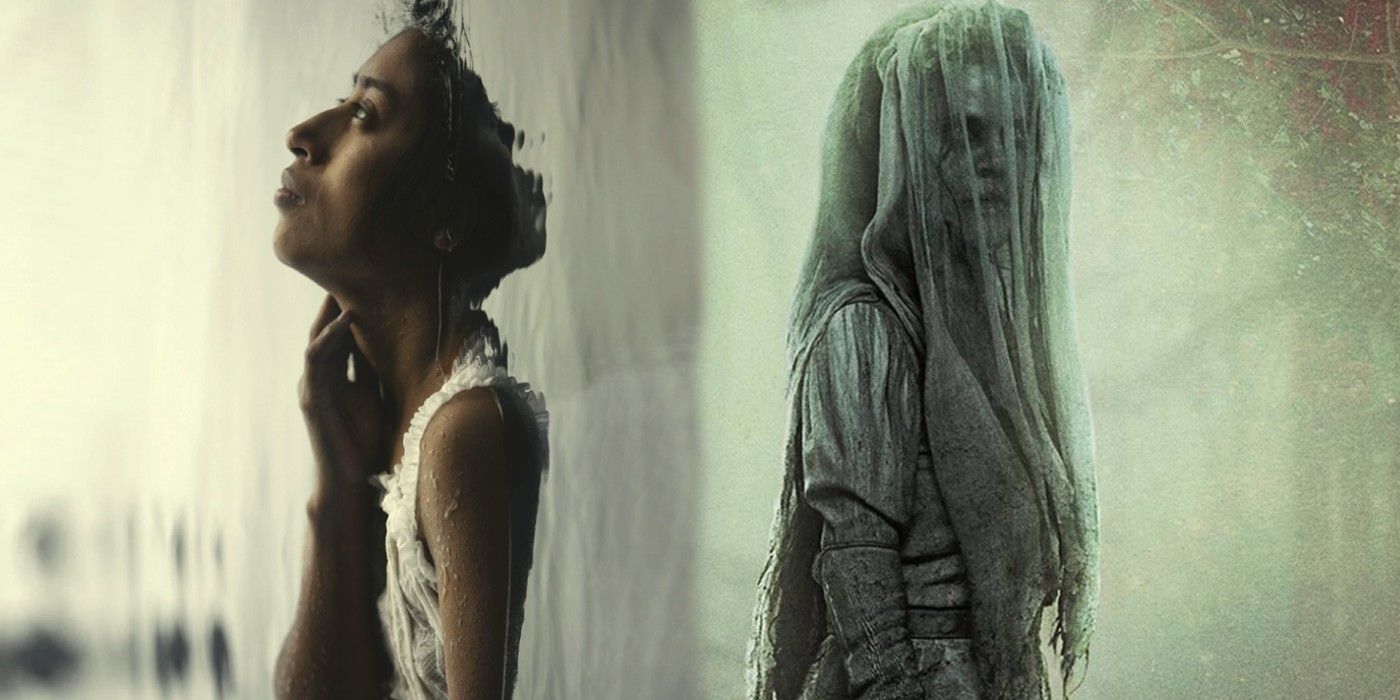
You've seen them. Those grainy, washed-out images of a woman in a tattered white dress standing by a riverbank or hovering near a highway in Mexico. They pop up on your TikTok feed at 2 a.m., accompanied by high-pitched violin screeches and a caption claiming a "security camera finally caught her." People lose their minds in the comments. They argue about shadows, pixels, and "bad vibes." But here is the thing about la llorona real pictures: they don't actually exist.
That sounds harsh. I know.
But if we are being honest, the legend of the Weeping Woman—the mother who drowned her children and now wanders the night in a state of eternal, agonizing regret—is far more powerful than any blurry JPEG could ever be. The "evidence" usually turns out to be a clever marketing stunt for a horror movie, a still from a 2011 YouTube prank, or just a really unfortunate case of pareidolia where a tree stump looks like a grieving ghost.
The obsession with finding a "real" photo of a folkloric entity says a lot about how we process fear in the digital age. We want proof. We want to see the "real" her, even though she is a creature of oral tradition that dates back centuries, potentially rooted in the weeping goddess Cihuacoatl or the historical figure of La Malinche.
The Most Famous "Real" Photos Are Actually From Movies
Most of the viral images circulating on Reddit or paranormal forums can be traced back to professional sets. It's kinda funny how a multimillion-dollar makeup job becomes "proof" of the paranormal once you add enough digital noise and lower the resolution to 144p.
Take the 2019 film The Curse of La Llorona. During its promotional cycle, stills of actress Marisol Ramirez in full spectral makeup were cropped and shared as "leaked" footage from a ranch in Chihuahua. People bought it. Why? Because the makeup design tapped into the collective subconscious of what we think a ghost should look like: sunken eyes, stained veils, and a jaw unhinged by a silent scream.
Then there is the infamous "white lady" photo from a graveyard in Montana that gets rebranded as La Llorona every October. It’s actually a long-exposure shot of a person moving quickly through the frame. It’s a trick of light. Physics, basically.
Why the Grainy Quality Matters for Believability
High definition is the enemy of the paranormal. If you saw a 4K, 60fps video of a woman crying by a river, you would immediately notice the zipper on her dress or the way her "spectral" veil is actually just polyester from a Spirit Halloween store.
The blurry nature of la llorona real pictures is a feature, not a bug. It allows our brains to fill in the gaps. Our minds are hardwired to find faces in the dark—a survival mechanism called pareidolia. When you look at a low-quality photo of a misty river, your brain desperately tries to organize that visual data. If you’ve grown up hearing stories of the Weeping Woman, guess what your brain is going to build out of that mist?
Exactly.
Folklore vs. The Digital Hoax
We have to look at the history to understand why these photos carry so much weight. The legend isn't just a spooky story; it’s a cultural touchstone.
Researchers like Dr. Domino Renee Perez, who wrote Llorona's Children, have spent years analyzing how this story evolves. It’s a narrative of colonization, motherhood, and loss. When someone posts a "real" photo, they are trying to modernize an ancient grief.
- The "Roadside Ghost" trope: Many photos claim to show her on a lonely highway. This is a modern update to the traditional riverbank setting.
- The "Security Cam" footage: This usually features a figure that disappears behind a pillar. These are almost always edited using simple masking tools in Adobe After Effects.
- The "Crying Audio" overlays: Often, a photo isn't enough. People add audio of a woman wailing. Fun fact: most of those "wailing" sounds are actually mountain lions or foxes recorded at night. They sound terrifyingly human.
The reality is that La Llorona belongs to the world of la plática—the talk. She lives in the stories told by grandmothers to keep kids away from dangerous, fast-moving water. When you try to pin her down with a camera lens, the magic—and the terror—sorta evaporates.
How to Spot a Fake "Real" Photo
If you stumble across a new lead on la llorona real pictures, you can usually debunk it in about thirty seconds. I’ve spent way too much time doing this.
First, look at the lighting. Is the "ghost" illuminated by a light source that isn't there? If the figure has a rim light on her shoulder but she’s in the middle of a dark field, it’s a composite image. Someone cut and pasted her there.
Check the metadata. If you can get the original file, the EXIF data often reveals the camera type or even the Photoshop version used. Most "leaked" photos have been scrubbed of this data, which is a massive red flag.
Look for "The Loop." If it’s a video, does the mist move in a repetitive pattern? Digital assets used in video editing software often have a 5-second loop. Real fog doesn't behave that way. Real fog is chaotic.
The Cultural Impact of the "Sighting"
In places like Xochimilco, Mexico, sightings are taken very seriously, but they rarely come with photos. The locals understand that seeing her is a spiritual or psychological event. To them, a photo is almost insulting. It reduces a massive, terrifying cultural archetype to a cheap jump scare.
The people who claim to have "real" photos are usually looking for clout or ad revenue. They tap into a deep-seated fear that is especially prevalent in Mexican and Chicano communities. It’s a form of digital folklore, sure, but it’s often disconnected from the actual weight of the myth.
The Psychology of Why We Want Her to Be Real
Honestly, it’s about the thrill.
We live in a world that feels very "found out." We have GPS, satellite imagery, and cameras on every street corner. The idea that there is still something out there—something that can’t be explained by science—is weirdly comforting. It suggests the world is still mysterious.
But searching for la llorona real pictures is a wild goose chase. You are looking for a physical manifestation of a psychological trauma. The "real" La Llorona isn't a lady in a dress; she’s the sound of the wind through the trees and the collective memory of a people who have known great sorrow.
Actionable Steps for Paranormal Enthusiasts
If you are genuinely interested in the "evidence" of La Llorona, stop looking at Google Images and start looking at the source material.
- Visit the archives: Look into the Codex Florentino. It describes omens that predated the fall of Tenochtitlan, including a woman wandering the streets crying for her children. No photos, but the descriptions are chilling.
- Reverse Image Search: Use tools like Google Lens or TinEye on any "sighting" you see. 99% of the time, it will lead you back to a Pinterest board for "Gothic Photography" or a horror movie promotional site from 2014.
- Study the Geography: Most sightings happen near water. Instead of looking for a ghost, look at the history of those locations. You’ll often find real, tragic histories that explain why the legend took root there in the first place.
- Analyze the Audio: If a video features a "cry," compare it to recordings of local wildlife. It’s a great way to learn about nature while debunking hoaxes.
The legend of La Llorona is a masterpiece of storytelling. It doesn't need "real" pictures to be terrifying. In fact, the versions you see in your own mind when the lights are out are much scarier than anything a grainy cell phone camera could ever capture. Stop searching for the pixels and start listening to the stories. That’s where she actually lives.