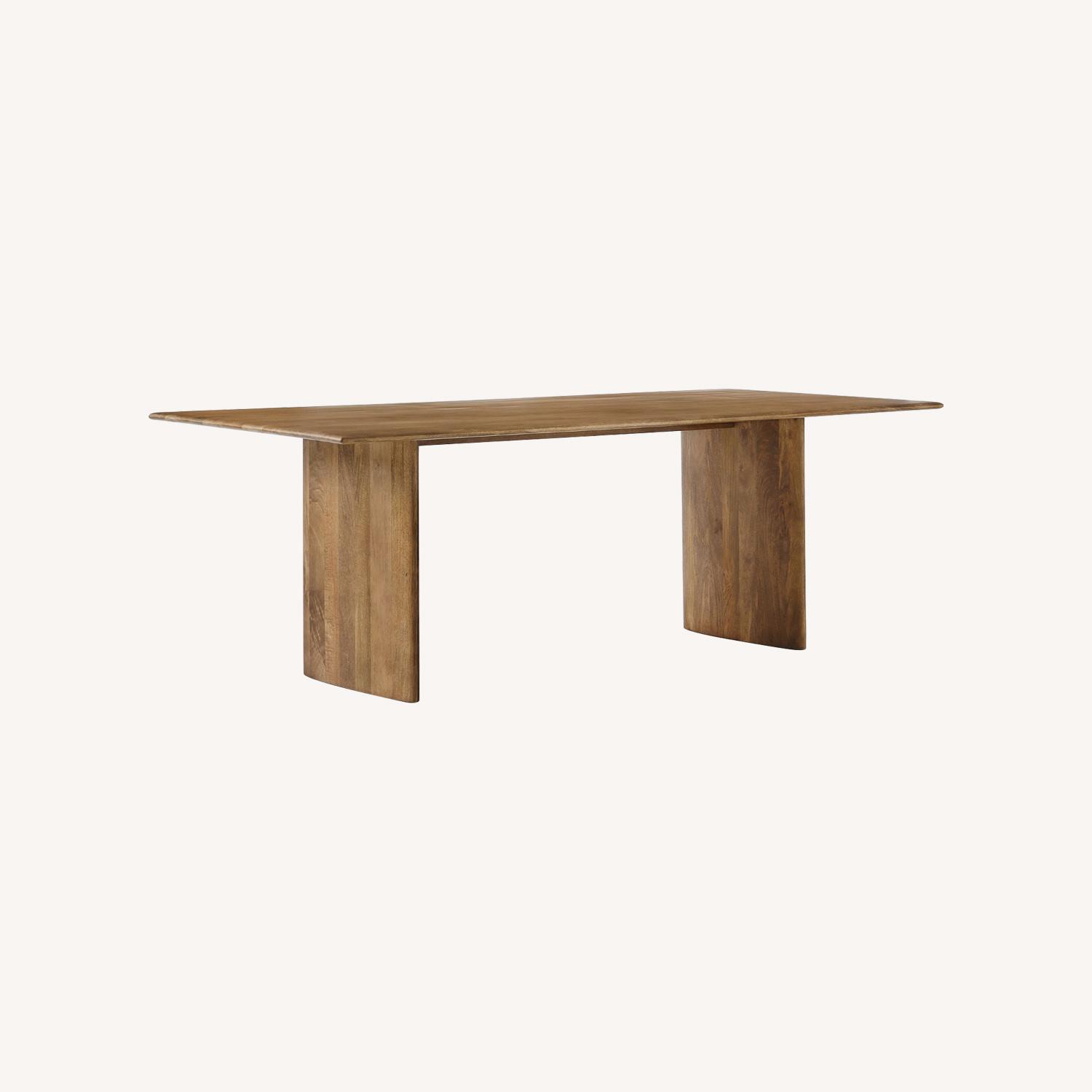
You’ve probably seen it. It’s that chunky, raw-looking slab of wood that seems to anchor every high-end "organic modern" mood board on Pinterest right now. The West Elm Anton solid wood dining table has become a sort of mascot for the shift away from flimsy, mid-century toothick legs toward something that looks like it was hacked out of a single tree in a very stylish forest. But let’s be real for a second. Dropping over a thousand dollars on a dining table isn't just a design choice—it's a financial commitment. You want to know if it’s going to split, if your kids are going to ruin it with a stray marker, and if it actually feels like real wood or some over-sanded veneer.
Honestly, the furniture market is flooded with "solid wood" claims that turn out to be thin layers of walnut over MDF. The Anton is different. It’s heavy. It’s brutalist. It’s surprisingly soft to the touch. But it isn't perfect, and depending on how you live your life, it might be a total nightmare to maintain.
What makes the Anton different from the rest of West Elm’s lineup?
Most West Elm furniture is known for being "apartment scale." It's usually a bit leggy, a bit thin, and designed to fit into a 600-square-foot Brooklyn walk-up. The West Elm Anton solid wood dining table throws that playbook out the window. It is chunky. The legs are thick, blocky pedestals that scream "I am never moving this table again without professional help."
Here is the technical stuff: it’s made from kiln-dried mango wood.
Mango wood is a fascinating choice for high-volume furniture. It’s technically a byproduct of the fruit industry. Once a mango tree stops producing those delicious snacks—usually after about 15 to 20 years—it becomes available for timber. This makes it more sustainable than harvesting slow-growth oaks or maples. But because it’s a tropical hardwood, it has a grain pattern that is incredibly "busy." You’ll see streaks of pink, yellow, and even black. West Elm manages this by using a multi-step finish, but no two Anton tables look the same. If you’re a perfectionist who wants a uniform, flat color, you are going to hate this table.
It’s about the texture.
The surface is slightly wire-brushed. This means they’ve run a metal brush over the wood to pull out the softer grains, leaving a tactile, "ridged" feel. When you run your hand across it, you feel the history of the tree. It’s not a plastic-smooth lacquer finish.
The Burnt Wax finish and the reality of "Solid Wood"
We need to talk about the finish because this is where most people get caught off guard. The most popular version is the "Burnt Wax." It’s a dark, moody brown that looks incredible under warm pendant lighting.
However, "wax" is the keyword here.
Standard dining tables often have a polyurethane topcoat. Poly is basically a thin layer of plastic that protects the wood from water. The West Elm Anton solid wood dining table uses a wax-based finish to keep that matte, natural look. It’s gorgeous. It’s also a magnet for water rings. If you leave a sweating glass of iced tea on this table for two hours, you might find a ghostly white circle staring back at you the next morning.
Is it "Fair Trade Certified"? Yes.
That matters more than people think. It means the factory in India where these are produced meets specific safety and wage standards. In an era of fast furniture, knowing that your table didn't come from a sweatshop adds a layer of value that isn't just about aesthetics.
Why the "Solid Wood" label is a bit of a trick
While the table is solid mango wood, it’s not a single slab. No one is selling a single-slab dining table for $1,200; those cost $5,000 at a local lumber yard. The Anton is constructed using "breadboard ends" and joined planks.
- The top is made of several planks glued together.
- The ends have a perpendicular piece of wood (the breadboard) that helps prevent the table from warping.
- This is standard, but because wood "breathes," you might see tiny gaps open and close between the planks as the seasons change and your HVAC kicks on.
That’s not a defect. That’s just wood being wood. If you want something that stays perfectly static forever, buy metal or glass.
Let’s talk about the "Banging Your Knees" problem
One thing nobody tells you about the West Elm Anton solid wood dining table is the leg placement. It uses a trestle-style base. On the smaller versions, the legs are set in quite a bit from the ends.
If you try to squeeze six people around the 72-inch model, the people on the ends are going to be fine, but the people in the middle are going to be fighting those blocky legs for legroom. It’s a bulky design. You have to account for the "visual weight." In a small room, this table can feel like an elephant. It dominates the space. But in a large, open-concept room? It’s the anchor that stops the room from feeling like it’s floating away.
Durability vs. "Vibe"
I’ve spoken with several interior designers who use the Anton in staging, and the consensus is always the same: it’s a "lifestyle" table.
If you have toddlers who treat the dining table like a drum set or a canvas for Sharpies, you are going to stress out. Mango wood is durable, but the wax finish is soft. It scratches. It patinas. Over five years, an Anton table will start to look "lived in."
For some people, that’s the goal! They want the scratches from a decade of dinner parties. For others, every little nick is a tragedy. If you fall into the latter camp, you should probably look at West Elm’s contract-grade items with a water-based clear coat instead.
How to actually take care of it without losing your mind
If you’ve already bought the West Elm Anton solid wood dining table, or you’re about to, stop buying Pledge.
Serious. Just stop.
Aerosol dusters and silicone-based cleaners will ruin the wax finish over time, creating a sticky residue that’s impossible to remove. Instead, you want to use a slightly damp (not soaking) microfiber cloth. For deeper cleans, a very mild soap is fine, but you have to dry it immediately.
Every six months or so, you might want to apply a high-quality furniture wax like Howard Feed-N-Wax. This keeps the mango wood from drying out and cracking, especially if you live in a climate with harsh winters where the air gets bone-dry.
The competition: Is there a better version?
You could go to Restoration Hardware and spend $4,000 on a similar look. You could go to IKEA and get a veneer table for $300. The Anton sits in that "middle-luxury" sweet spot.
- Pottery Barn’s Benchwright: Similar price, but much more "farmhouse" with visible bolts and a more rustic feel.
- Article’s Seno: Solid wood but much thinner, mid-century legs. Doesn't have the same "chunk" factor.
- Crate & Barrel’s Yukon: This is the closest competitor. It has a live-edge look with metal legs. It feels a bit more industrial-modern than the Anton's organic-minimalist vibe.
The Anton wins on the "warmth" factor. There is something about the way the light hits the Cerused White or the Burnt Wax finish that makes a room feel expensive but approachable.
What most people get wrong about the assembly
Don't do it yourself.
I mean, you can. The instructions are straightforward. But these pieces are incredibly heavy. The legs alone weigh more than some entire tables from big-box stores. If you try to flip the table over by yourself after attaching the legs, you risk snapping the mounting hardware or, worse, your back. Pay for the "White Glove" delivery. They’ll bring it in, put it exactly where you want it, and take the mountain of cardboard away. It is the best $150-200 you will ever spend.
Is it a "Forever Table"?
The term "forever furniture" gets thrown around a lot. Usually, it refers to heirloom pieces passed down through generations. Is the West Elm Anton solid wood dining table an heirloom?
Maybe.
Construction-wise, it’s sturdy enough to last 20 years. Style-wise, it’s trendy, but it leans into "Primary Forms"—blocks, rectangles, natural materials. These things tend to age better than hyper-specific trends like "Chevron everything."
The biggest threat to its longevity isn't the style; it's the owner's willingness to maintain the wood. If you ignore it, it will dry out. If you treat it like a workbench, it will look like one. But if you respect the grain, it’s a piece that will actually look better when it’s ten years old than it did in the showroom.
Immediate steps for potential buyers
Before you click "add to cart," take a piece of painter's tape and mask out the dimensions on your floor.
People constantly underestimate how much space those thick legs take up. You need at least 36 inches of clearance between the table edge and the wall to actually pull a chair out comfortably. Because the Anton is so visually "heavy," I’d actually recommend 42 inches if you can manage it.
- Check your chairs: If you have chairs with wide bases or armrests, measure them against the Anton’s leg spacing. You don't want to find out on delivery day that your chairs won't tuck in.
- Order the swatch: West Elm offers wood swatches. Mango wood varies wildly. Get the swatch, put it in your room’s natural light, and see if that "Burnt Wax" actually works with your floors.
- Budget for coasters: Buy them now. You’re going to need them. Marble, leather, or felt—it doesn't matter, just make sure they are within arm's reach of every seat.
The West Elm Anton solid wood dining table is a statement. It’s a commitment to a specific, earthy aesthetic that values the "imperfections" of nature over the sterile perfection of factory-made laminates. It requires a bit of babying, and it’s a beast to move, but as a centerpiece for a home, it’s hard to beat the raw, architectural presence it brings to a room. Keep the wood hydrated, use a placemat, and it’ll likely be the last table you need to buy for a very long time.