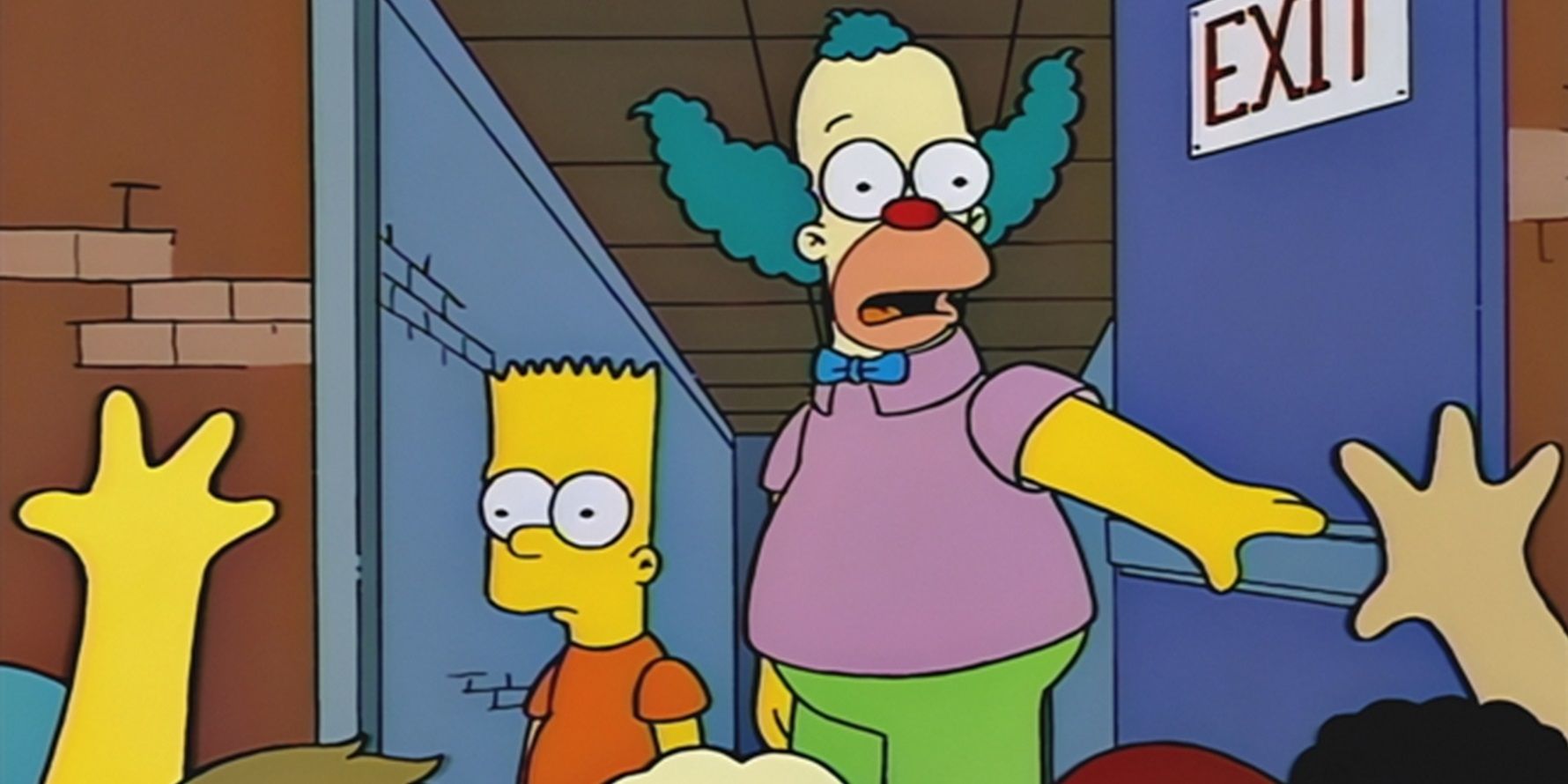
It is one of those things you can't unsee once you notice it. You’re sitting on your couch, watching a classic Season 4 episode, and it hits you. Homer Simpson and Krusty the Clown are basically the same person. They have the same overbite. The same beer belly. The same three-strand hair configuration (if you ignore Krusty’s teal tufts). Even their silhouettes are nearly indistinguishable.
Why?
Was it just lazy animation? A coincidence? Not even close. Matt Groening, the creator of The Simpsons, did this on purpose. It wasn't about saving time in the ink-and-paint department. It was a planned narrative arc that would have fundamentally changed how we view the Simpson family dynamic. Honestly, the real story behind their identical character designs is way more interesting than the "secret twin" theories you see floating around Reddit.
The Secret Origin of the Homer and Krusty Connection
Matt Groening’s original conceit for the show was actually pretty dark. He wanted Bart Simpson to have absolutely zero respect for his father, Homer, while idolizing a television clown who—unbeknownst to Bart—was actually his father in disguise.
Think about that for a second.
The satire was supposed to be biting. Groening’s logic was that Bart would worship the "fake" version of his dad while treating the "real" version like garbage. It’s a classic commentary on celebrity culture and how we project our desires onto public figures while ignoring the humanity of the people right in front of us. In those early development meetings, the plan was for Homer Simpson to lead a double life. By day, he was the bumbling nuclear plant safety inspector; by night, he slapped on some greasepaint and became the cynical, chain-smoking Krusty the Clown.
Eventually, the writers realized this was way too complicated. Trying to maintain a secret identity in a town as small as Springfield felt like a stretch, even for a cartoon. They abandoned the "Homer is Krusty" twist, but they kept the character models.
Homage, Not Laziness: Homie the Clown
The show eventually addressed the elephant in the room during the Season 6 episode "Homie the Clown." If you haven't seen it in a while, it’s arguably one of the tightest-written twenty minutes in television history. Homer, in a fit of impulsive spending, joins Krusty's Clown College. Because they look so similar, Homer starts standing in for Krusty at public appearances.
It gets weirdly meta.
Homer gets kidnapped by the Italian mob because Krusty owes them gambling money. The joke, of course, is that the mobsters can't tell the difference either. Seeing the two of them standing side-by-side on a tiny tricycle is the ultimate payoff for fans who spent years pointing at the screen and shouting, "They’re the same guy!"
But the similarities go deeper than just the face.
The Shared DNA of Failure and Vice
Both characters represent different facets of the "American Loser." Homer is the blue-collar version—stuck in a dead-end job, fueled by donuts and Duff, yet somehow sustained by a loving family. Krusty is the Hollywood version. He has the money and the fame, but he’s miserable. He’s addicted to everything. He has a pacemaker. He’s illiterate (well, sometimes, depending on the episode's needs).
They both suffer from a desperate need for validation. Homer wants it from his neighbors and his kids. Krusty wants it from an audience that is mostly made up of children he doesn't actually like. When you look at Homer Simpson and Krusty the Clown, you're looking at two sides of the same mid-life crisis.
- Homer's Vice: Gluttony and sloth.
- Krusty's Vice: Greed, gambling, and Percodan.
There’s a reason why Dan Castellaneta voices both of them. He just gives Krusty a gravelly, "I’ve smoked three packs a day since 1964" rasp. If you strip away the clown voice, the cadence is identical. It’s a masterclass in voice acting that reinforces the visual gag every single time they speak.
Animation Shortcuts or Brilliant Branding?
In the early days of Klasky Csupo (the original animation studio for the show), character "turnarounds" were strictly enforced. A character like Homer was designed to be easy to draw from any angle. By using that same template for Krusty, the animators could produce scenes faster.
But it also served a psychological purpose.
Springfield is a town of archetypes. There’s the "Drunk," the "Nerd," the "Corrupt Mayor." By having the "Dad" and the "Entertainer" share a face, the show subtly suggests that these roles are interchangeable. In the eyes of the consumer (Bart), the person providing the entertainment is just as much a parental figure as the guy paying the mortgage.
The resemblance is so baked into the show's lore that other characters rarely mention it, which makes the few times they do even funnier. Remember when Homer tried to buy a "Speedway" jacket and the clerk thought he was Krusty? Or when Krusty tried to walk through the Simpson house and even Marge did a double-take?
Why the "Secret Identity" Idea Was Dropped
The writers—specifically legends like Sam Simon and Al Jean—felt that the show needed more heart than a "secret identity" gimmick would allow. If Homer was secretly Krusty, every episode would have to be about the lie. It would turn The Simpsons into a sitcom version of Batman.
By separating them into two distinct people who just happen to be doppelgängers, the writers opened up a much larger world. We got the tragic backstory of Rabbi Krustofsky. We got the "Krusty Gets Busted" episode where Sideshow Bob frames him. None of that works if Homer is under the makeup.
It’s a rare instance where "less is more." Keeping them as two separate, identical men makes the world of Springfield feel more surreal and hilarious. It’s a running gag that doesn't need a punchline.
The Takeaway for Fans
If you're looking to dive deeper into the Homer Simpson and Krusty the Clown rabbit hole, there are a few things you should do to truly appreciate the craftsmanship of this design choice.
First, go back and watch "Homie the Clown" (Season 6, Episode 15). Pay close attention to the scene where they both perform the "clown college" stunts. The animation team went out of their way to ensure their body language was slightly different despite their identical frames. Homer is more fluid and "rubbery," while Krusty is stiff and world-weary.
Next, look at the early Tracy Ullman shorts. You can see the evolution of the designs there. Krusty wasn't as polished back then, and neither was Homer, but the shared "muzzle" (the tan area around the mouth) was present from day one.
Finally, consider the legacy. In almost 40 years of television, no other show has dared to have its lead and its most prominent supporting character look exactly the same without it being a major plot point every single week. It’s a testament to the strength of the character writing that we accept them as two completely different entities.
Next time you see Krusty on a billboard in the background of a scene, look at his eyes. Then look at Homer. It’s the same blank, slightly confused stare. It’s a reminder that in Springfield, everyone is just a few bad decisions away from being a clown.
Actionable Insights for Simpsons Historians:
- Watch the commentary tracks: If you have the DVDs or access to certain digital extras, Matt Groening explicitly discusses the "Homer-is-Krusty" origin theory in the Season 1 and Season 6 commentaries.
- Analyze the "Muzzle": Note that the tan beard/mouth area is a design trait shared almost exclusively by these two and Grampa Simpson, suggesting a "genetic" design language for the Simpson-esque male.
- Check the Merch: Early 1990s merchandise often played up the similarity, sometimes accidentally using the wrong character model for licensed products, which has since become a collector's niche.