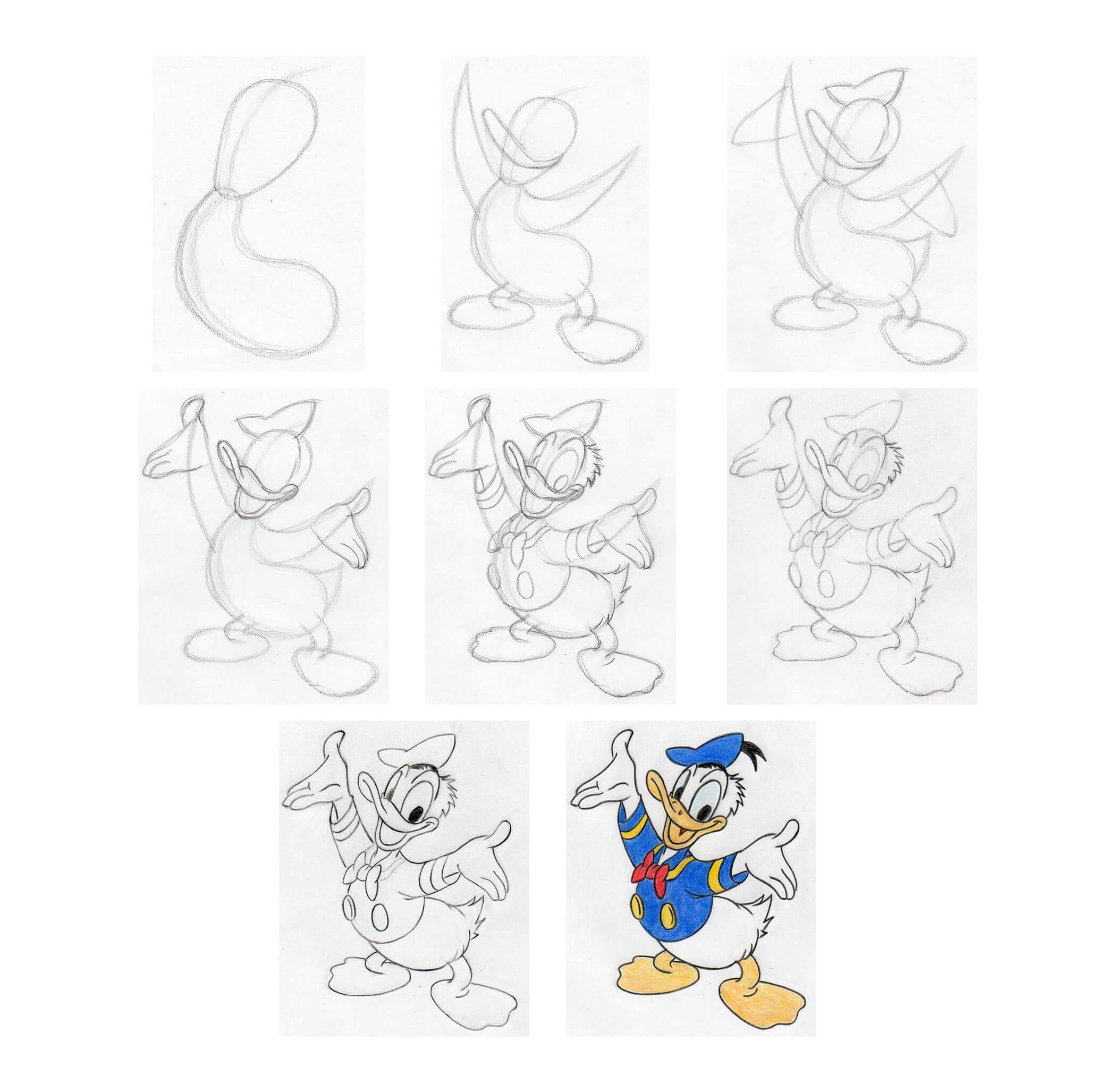
Honestly, trying to sketch Disney characters can feel like a trap. You start with a circle, thinking "I've got this," and ten minutes later, you've accidentally drawn a sleep-deprived goose in a hat. If you’ve ever Googled donald duck drawing easy only to end up with a crumpled ball of paper and a frustrated sigh, you aren't alone. Donald is notoriously tricky because his proportions are deceptively specific. He isn't just a bird with a shirt; he’s a masterpiece of mid-century squash-and-stretch animation.
Getting him right isn't about being a "natural" artist. It's about knowing where the cheats are.
The Circle Trick That Actually Works
Most tutorials tell you to start with a circle. That’s fine, but it’s incomplete. To make a donald duck drawing easy, you need to think about the "cheeks." Donald doesn’t have a round head like Mickey; he has a squashed oval that bulges at the bottom.
Think of his head like a soft bag of flour that’s been dropped on a table.
Start with that squashed oval. Then, instead of just sticking a beak on the front, draw a light "cross" across the face to find the center. This is where most people mess up—they put the eyes too high. Donald’s eyes are huge, and they actually sit quite low on his face, almost touching the top of his bill.
Getting the Bill Right
The bill is the soul of the character. If it's too long, he looks like a real duck (boring). If it's too short, he looks like a weird puffin.
- Draw a wide "U" shape that stretches across the bottom third of the head.
- Add a little "bump" in the middle of that U for the top of the beak.
- The corners of his mouth should have little "smile lines" even if he's looking grumpy.
Disney legend Carl Barks, the man who basically built the "Duck Universe," often emphasized that the bill should be expressive. It shouldn't just be a solid piece of plastic. It bends. It twists. When Donald is mad—which is usually—the bill actually flattens out.
Why the Sailor Hat is Your Best Friend
The hat is the ultimate "fix-it" tool. If the top of the head looks a bit wonky or too flat, the hat hides a multitude of sins.
Basically, you’re drawing a small, tilted pancake on top of his head. Don’t center it. Donald is a chaotic guy; his hat should reflect that. Tilt it to one side. Then, add the little black ribbon hanging off the back. Two quick lines and a little "V" at the end.
The ribbon adds motion. Even in a static drawing, it makes it look like he just landed from a tantrum.
Proportions: The 3-Circle Secret
If you want to draw the full body and not just the face, stop thinking about anatomy. Donald doesn't have a neck. Not really. His head sits almost directly on his pear-shaped body.
Imagine three circles. One for the head (the squashed oval), one for the upper chest (small), and one for the "butt" (large).
The "butt" is actually the most important part of his silhouette. It’s where his tail feathers flick up. Without that specific curve, he just looks like a guy in a costume. You want a sharp, flicking "V" shape at the very back of the largest circle.
The Sailor Suit Details
You don't need to be an expert in 1930s naval attire. Just remember the big four:
- The Collar: It’s a wide rectangle that drapes over the shoulders.
- The Bow: Two simple loops. Don't overthink it.
- The Buttons: Two big circles on the front.
- No Pants: This is the easiest part of the drawing. You literally just don't draw pants.
Common Mistakes Beginners Make
I see this all the time in "easy" tutorials. People try to draw fingers.
Donald doesn’t really have fingers in the traditional sense; he has four "feathers" that act like fingers. They should be thick and rounded at the tips. If you draw thin, human-like fingers, the whole thing goes into the "uncanny valley" real fast.
Another big one? The feet.
Donald’s feet are massive. They are basically large, flat triangles with two small lines to indicate toes. If you make them too small, he looks top-heavy. Give him those big, sturdy flippers so he looks like he can actually stand up.
Making Him Look Like "Donald"
The secret isn't in the lines; it's in the expression. Donald is rarely "neutral." He is either ecstatic, devious, or—90% of the time—absolutely livid.
To get that classic "I’m about to explode" look, pull the eyebrows down toward the center of the eyes. The eyes themselves shouldn't be perfect ovals. Squash them down. Make the pupils small.
If he’s happy, the eyes should be wide and the bill should have a deep curve.
Actionable Next Steps
If you want to actually improve, stop drawing from memory.
- Find a Model Sheet: Search for "Donald Duck 1940s model sheet." These are the guides professional animators used to keep the character consistent. They show him from every angle.
- Use a Blue Pencil: Professional artists use light blue pencils for the "rough" shapes because the eye ignores blue once you go over it with black ink. It lets you be messy with your circles without ruining the final look.
- The "Ghosting" Technique: Before you put your pencil to the paper, move your hand in the shape of the circle a few times in the air. Then, let the pencil touch the paper. Your lines will be much smoother.
- Focus on the Eyes First: Once you nail the eyes and the bridge of the nose (the "mask" area), the rest of the drawing usually falls into place.
Drawing should be fun, not a chore. If your first few tries look more like Howard the Duck than Donald, that’s fine. Keep the shapes simple, keep the "butt" feathers pointy, and don't forget the tilt on the hat.
Now, grab a fresh sheet of paper and start with that squashed oval. You've got this.