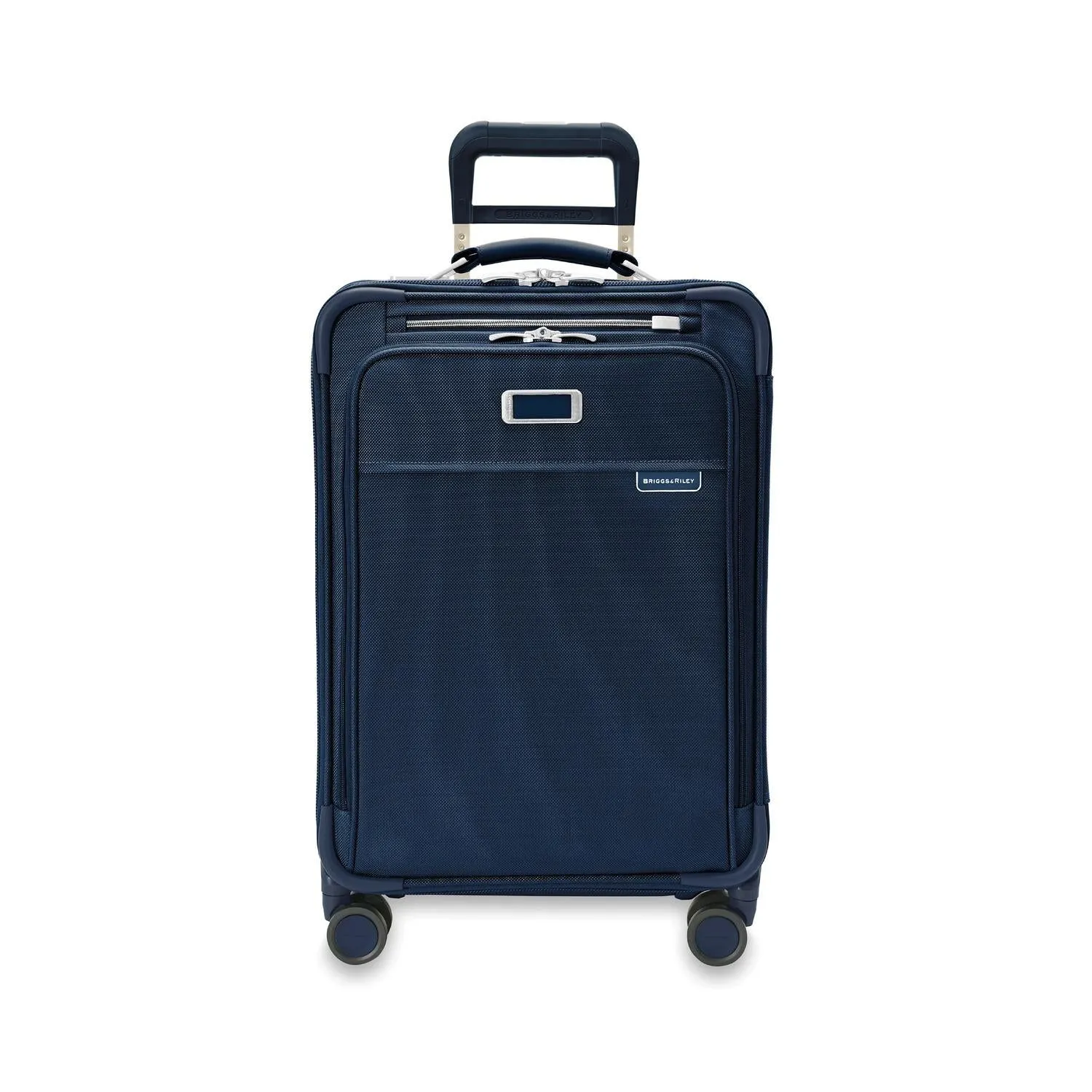
You’ve seen them in the wild. Those sleek, olive-colored bags gliding through the Delta Sky Club or trailing behind a pilot in a crisp uniform. Usually, it's the Briggs & Riley Baseline Essential Carry On Spinner. It isn't just a suitcase; it’s a bit of a cult object. Honestly, if you’re tired of replacing your luggage every three years because a wheel snapped off or the zipper gave up the ghost, this is where the conversation starts.
But here is the thing: it’s expensive. Like, "I could buy three other decent bags for this price" expensive. So, does it actually earn its keep, or are you just paying for the logo and a lifetime warranty? Let's get into the weeds of what actually makes this bag work, because most people focus on the wrong things.
The CX Expansion Secret
Most "expandable" bags are kind of a scam. You unzip a side, the bag gets floppy, and suddenly it's too fat to fit in the overhead bin. The airline attendant gives you that look, and you're forced to gate-check it.
Briggs & Riley does it differently. Their one-touch CX expansion system is basically a mechanical lift for your luggage. You click two buttons inside, the whole frame pops up, and you pack it to the gills. Then—and this is the magic part—you zip it shut and push down. The bag ratchets back down to its original size, compressing your clothes like a vacuum sealer without the vacuum.
It’s satisfying. You can hear the clicks. More importantly, it keeps your clothes from shifting around during the flight. If you've ever opened your bag to find your neatly folded shirts in a pile at the bottom, this is the fix.
Why the Handle is on the Outside
Look at the back of any normal suitcase. You see those two big bumps from the handle tubes? Those are space-killers. They create "valleys" in your packing space that you have to fill with rolled-up socks or underwear just to make the floor flat.
The Outsider handle on the Baseline is mounted on the exterior. This means the inside of the bag is a perfectly flat rectangle. You can lay a suit or a dress flat against the bottom without it bending over those metal ribs. It sounds like a small detail. It isn't. It’s the difference between arriving with a pressed shirt or a wrinkled mess.
Reality Check: The Weight Penalty
We need to be real for a second. This bag is a tank, and tanks aren't light.
The Briggs & Riley Baseline Essential Carry On Spinner weighs in at roughly 10 lbs. Compared to a featherweight hardshell from a brand like July or Away—which might be 7 lbs—that’s a significant chunk of your carry-on allowance if you’re flying a picky international carrier like Lufthansa or Qantas.
- Domestic is Fine: If you're flying United, Delta, or American, they rarely weigh carry-ons.
- International is Tricky: If you have a 7kg (15lb) limit, this bag takes up two-thirds of that before you even put a sock in it.
- The Trade-off: You’re trading lightness for durability. That 1680D ballistic nylon is basically bulletproof. You can drag it across cobblestones in Rome, and it won't care.
Does it Actually Fit the Bin?
The "Essential" model is 22 inches tall. This is the sweet spot for US domestic travel. It fits perfectly into the overhead of a Boeing 737 or an Airbus A320.
However, if you do a lot of hopping around Europe on small regional jets, it might be tight. For those flyers, the "Global" version (which is 21 inches) is usually the safer bet. But for the average US business traveler? The 22-inch Essential is king. It maximizes every millimeter of the "sizer" box at the gate.
Those Spinner Wheels
Four wheels vs. two wheels is the eternal debate. Spinners are great because you can navigate a crowded terminal with zero effort. The shock-absorbing wheels on the Baseline are incredibly quiet. They don't have that "rumble" that makes everyone look at you when you're walking through a quiet airport at 5 AM.
One thing people get wrong: they try to pull a spinner on two wheels over carpet. Don't do that. Keep it on all four. The Baseline is balanced well enough that it won't tip over, even if you have a heavy laptop bag perched on top via the SmartLink strap.
The Warranty Nobody Believes
"Simple as That" is the name of their warranty. It is arguably the best in the world.
If United Airlines decides to use your bag as a wheel chock and crushes the frame, Briggs & Riley will fix it. For free. Forever. Most brands have "limited" warranties that cover "manufacturing defects" (which basically means nothing). Briggs covers "functional damage."
I’ve met travelers who have used the same Baseline bag for twenty years. They’ve sent it in for new wheels or a handle replacement three times, and the bag is still going. When you do the math, paying $700 once is a lot cheaper than paying $250 every four years for a bag that breaks.
Inside the Organization System
The interior isn't just a big hole. It has a built-in tri-fold garment folder with a foam roll bar.
- Suits: It holds two suits easily.
- Mesh Pockets: Two of them on the lid for chargers or toiletries.
- PowerPocket: On the back, there’s a spot for a battery pack so you can charge your phone while waiting for your flight.
The lining is a light color, which seems like a weird thing to mention until you're trying to find a black charging cable at the bottom of a dark bag in a dimly lit cabin. It makes everything pop.
Is it Worth the Investment?
Look, if you travel once a year to visit your parents, this bag is overkill. You don't need it. Go buy a $150 Samsonite and spend the rest on a nice dinner.
But if you are on a plane every other week? If you live out of a suitcase? The Briggs & Riley Baseline Essential Carry On Spinner is a tool. It’s like a good pair of boots or a high-end chef's knife. It removes the friction of travel. You don't worry about the zipper snagging. You don't worry about it being too fat for the bin. You just go.
Actionable Tips for New Owners
If you decide to pull the trigger, here is how to actually use it properly:
- Don't overstuff the front pocket: It's tempting to shove your laptop in there, but it can make the bag "nose-heavy" if you aren't careful.
- Use the compression strategically: Pack your heavy stuff (shoes, jeans) at the bottom near the wheels to keep the center of gravity low.
- Register the bag: Do it the day you get it. Their digital "Lost and Found" tag system actually works.
- Clean the wheels: Every six months, wipe the hair and gunk out of the spinner axles. It keeps that "gliding on ice" feeling alive.
The real test of a bag isn't how it looks in the showroom. It’s how it feels when you’re sprinting for a connection in O’Hare. The Baseline doesn't fight you. It just follows. That peace of mind is exactly what you're paying for.